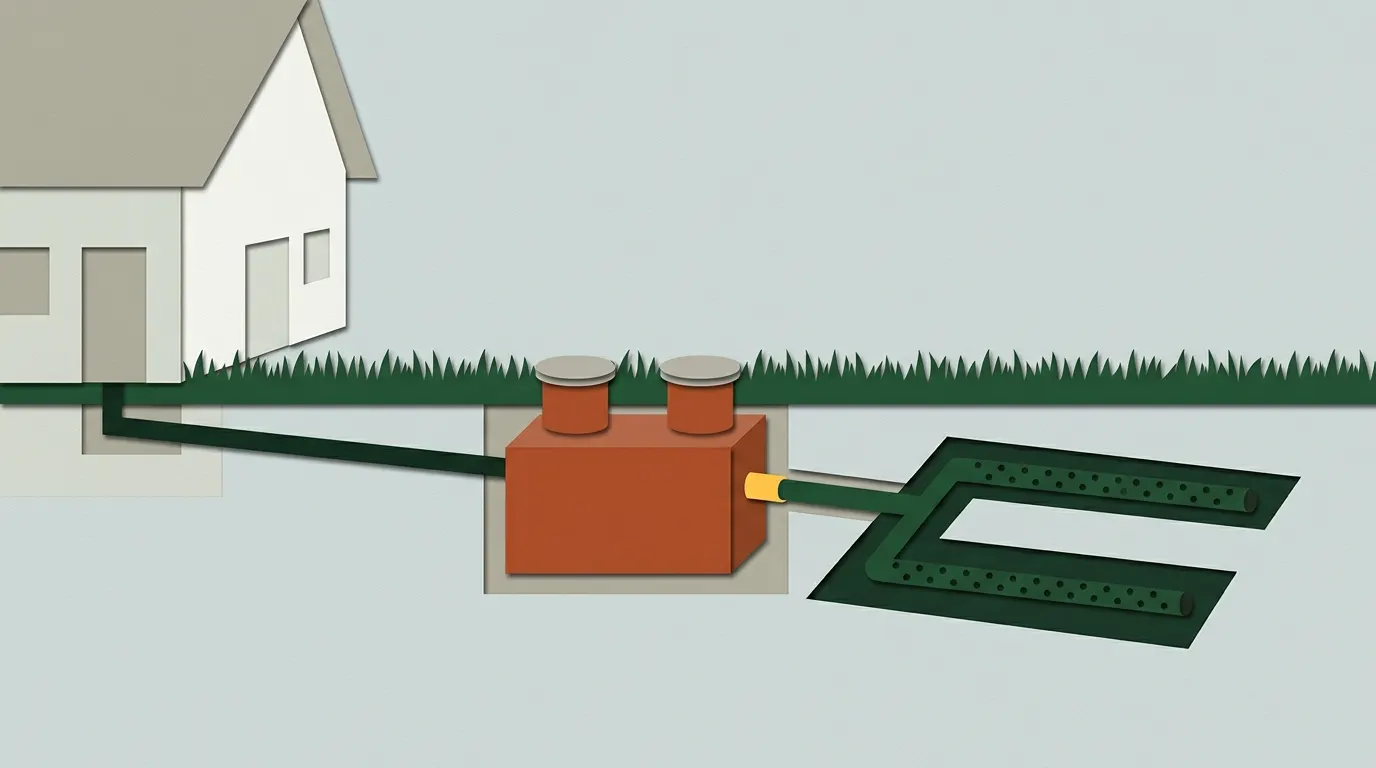
National ballpark · a new conventional septic system for a 3-bedroom home
This is a planning range, not a quote.
Limited data: new conventional system (sources disagree); perc test (sources disagree); permit fee (adjusted range). The real range may be wider.
| Cost | Low | Typical | High |
|---|---|---|---|
| Materials | $1,200 | $2,200 | $3,200 |
| Labor | $1,800 | $3,300 | $4,800 |
| Perc (soil) test | $600 | $900 | $1,500 |
| Permit (varies by city) national | $250 | $250 | $2,300 |
| Total | $3,850 | $6,650 | $11,800 |
| For reference (not added to the total) | |||
| Tank alone (material) for 3 bedrooms — per tank | $900 | $1,200 | $1,500 |
How this septic tank replacement cost calculator works
Enter your ZIP code and pick the job: a new system, a tank replacement or a drain field replacement. For a new system, choose the system type as well. The bedroom count is there because it drives tank size under most local codes, but in our data it doesn't change the job price.
For a new system, the calculator takes the installed price for that type and adds a perc test and the permit. For a tank or drain field replacement, it takes the price of that job and adds the permit. Then it adjusts the labor and materials for your state. Labor follows construction wages from the Bureau of Labor Statistics, and materials follow regional price levels from the Bureau of Economic Analysis. The permit stays at the national range, since local health departments set it. The full method is on our How we calculate page.
You see a low, typical and high price, plus a breakdown into materials, labor, the perc test and the permit. For the default new conventional system, that's materials of $1,200–$3,200 (typical $2,200) and labor of $1,800–$4,800 (typical $3,300). Labor is the larger share, so a contractor's crew rate moves the price more than the tank does.
Septic system cost by type
The system type is set by your soil and lot, not by preference. A perc test and a site evaluation tell the designer which types will work.
| Option | Low | Typical | High | Unit |
|---|---|---|---|---|
| Conventional * | $3,000 | $5,500 | $8,000 | project |
| Chamber | $5,000 | $8,500 | $12,000 | project |
| Mound | $10,000 | $12,000 | $20,000 | project |
| Aerobic | $10,000 | $15,000 | $20,000 | project |
* Limited data: one source, sources that disagree widely, or a single figure.
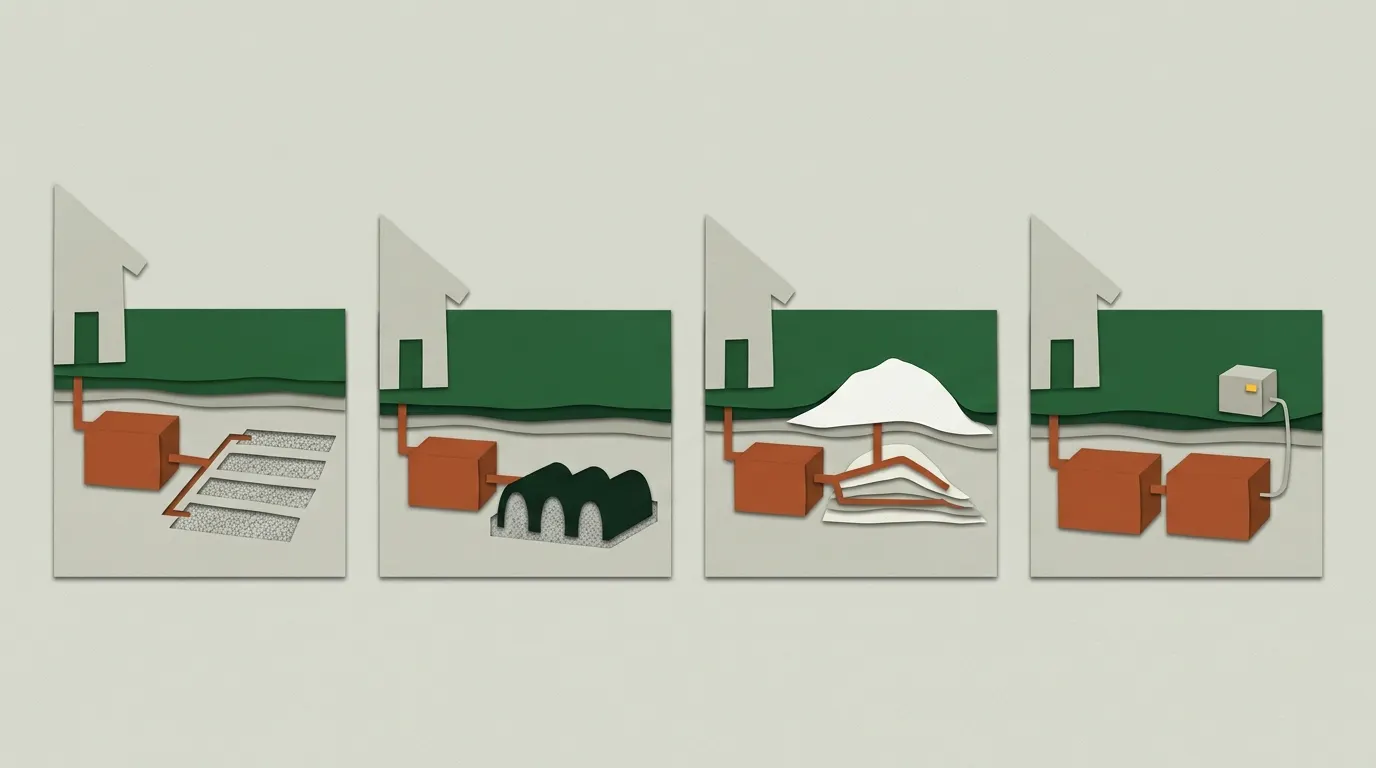
- Conventional. A tank and a gravity drain field of pipes in gravel trenches. The simplest and least expensive, at $3,000–$8,000 installed, typical $5,500. Our sources spread widely on this one, so the range is rough.
- Chamber. The same idea, with plastic chambers in place of gravel. It runs $5,000–$12,000, typical $8,500, and can fit where gravel is hard to bring in.
- Mound. A raised bed of sand for shallow soil or a high water table. It runs $10,000–$20,000, typical $12,000.
- Aerobic. A treatment unit that adds air to break waste down before it reaches the yard. It runs $10,000–$20,000, typical $15,000, and it has parts that need regular service.
With the perc test and permit, the calculator's totals are $3,850–$11,800 for conventional, $5,850–$15,800 for chamber, and $10,900–$23,800 for both mound and aerobic. The typical mound job comes to $13,200 and the typical aerobic job to $16,200.
Septic tank replacement vs. a full new system
Most owners searching for septic system cost face one of three jobs. A tank replacement swaps a cracked or failing tank and reconnects it to a drain field that still works. It runs $3,250–$12,300 in the calculator, typical $6,750. A drain field replacement keeps the tank and rebuilds the field, at $3,250–$17,300, typical $7,250. A new system covers both, plus the perc test.
A tank or field job doesn't include a perc test in our calculator. If your county requires a new soil test before a drain field is rebuilt, add it: $600–$1,500, typical $900.
Septic tank cost calculator: the tank by itself
The tank is a smaller part of the bill than most people expect. Excavation, setting the tank, connecting the pipes and backfilling make up most of the cost. The table below shows what the tank alone costs as material, by home size. It's for reference and isn't added to your total.
| Option | Low | Typical | High | Unit |
|---|---|---|---|---|
| 2 bedrooms | $700 | $950 | $1,200 | tank |
| 3 bedrooms | $900 | $1,200 | $1,500 | tank |
| 4 bedrooms | $900 | $1,200 | $1,500 | tank |
| 5+ bedrooms | $1,200 | $1,400 | $1,600 | tank |
A tank for a 3-bedroom home runs $900–$1,500, typical $1,200. Tanks for 3 and 4 bedrooms cost the same in our data. Ask the installer which tank material your local code allows and why they'd pick it for your yard.
What affects the price
System type
The biggest factor by far. Moving from a conventional system to a mound or aerobic unit can roughly double the typical price, and your soil may leave you no choice.
The job
A tank replacement and a drain field replacement have similar typical prices in our data, but the drain field has a much higher top end. A large field in poor soil is the most expensive piece of most septic jobs.
Soil and the perc test
The perc test decides what you can build. It runs $600–$1,500, typical $900, with a wide spread between sources. A failed test usually points to a mound or aerobic system.
The permit
Septic permits come from the county or local health department. Our sources put the fee at $250–$2,300. They disagree enough that the low and typical figures are both $250, so treat the permit line as rough and call your health department for the real fee.
Lot access and depth
A tank deep in the ground, behind a fence or under a deck takes more digging and more labor. None of our sources price access separately, which is one reason the high end sits well above the typical number.
When to budget toward the high end
The typical price assumes open access for the excavator, soil that passes the perc test and a site with no unusual rules. Plan nearer the high number if your lot is small, sloped or wooded, if the old tank sits under a patio or driveway, or if the county asks for an engineered design. Restoring the lawn, fences or plantings afterward is usually a separate cost, so ask whether the quote includes it.
Septic system cost by state
Labor is about 60% of a septic job in our data, so local wages drive most of the difference between states. For a new conventional system, the typical price is lowest in Arkansas at $5,550, Mississippi at $5,730 and West Virginia at $5,760. It's highest in Illinois at $8,090, New Jersey at $8,360 and Hawaii at $8,920.
- Alabama$6,070
- Alaska$7,690
- Arizona$6,470
- Arkansas$5,550
- California$7,890
- Colorado$6,780
- Connecticut$7,600
- Delaware$6,440
- District of Columbia$7,760
- Florida$6,120
- Georgia$6,320
- Hawaii$8,920
- Idaho$6,500
- Illinois$8,090
- Indiana$7,110
- Iowa$6,820
- Kansas$6,120
- Kentucky$6,250
- Louisiana$6,190
- Maine$6,410
- Maryland$7,020
- Massachusetts$7,290
- Michigan$6,640
- Minnesota$7,760
- Mississippi$5,730
- Missouri$6,640
- Montana$6,870
- Nebraska$7,110
- Nevada$7,320
- New Hampshire$7,250
- New Jersey$8,360
- New Mexico$5,930
- New York$7,720
- North Carolina$6,130
- North Dakota$6,480
- Ohio$6,690
- Oklahoma$5,760
- Oregon$7,530
- Pennsylvania$6,740
- Rhode Island$6,820
- South Carolina$6,080
- South Dakota$6,140
- Tennessee$5,900
- Texas$6,070
- Utah$6,580
- Vermont$6,400
- Virginia$6,470
- Washington$7,970
- West Virginia$5,760
- Wisconsin$7,290
- Wyoming$6,540
Ways to lower the cost
- Ask for an inspection before replacing. A damaged baffle, lid or inlet pipe can sometimes be repaired without a new tank.
- Price the tank and the field separately. If only one part has failed, you may not need a full new system.
- Get the perc test first. It tells you which system types are possible before you collect quotes.
- Compare system types the site allows. If both a chamber and a conventional system will work, ask for both prices.
- Plan access. Clearing a path for the excavator can cut labor time.
Hiring tips
Get at least three written quotes for the same job and system type. Each quote should list the tank, the drain field work, excavation, backfill, the perc test, the design if your county requires one, the permit and old tank removal or abandonment. Compare them with the breakdown above.
Ask who designs the system, who pulls the permit and who schedules the county inspection. Check whether your state or county licenses septic installers; if it does, ask for the license number and verify it. Ask for proof of insurance too. Get the start date, payment schedule and warranty in writing. Bring the ballpark. Ask for the line items.
Other big-ticket jobs in this group, such as the HVAC replacement cost calculator and the furnace replacement cost calculator, are on the Home Systems page.