National ballpark · one 30–60 ft tree, without stump grinding or haul-away
This is a planning range, not a quote.
| Cost | Low | Typical | High |
|---|---|---|---|
| Tree removal | $450 | $740 | $1,040 |
| Permit (varies by city) national | $60 | $110 | $150 |
| Total | $510 | $850 | $1,190 |
How the tree removal calculator works
Enter your ZIP code, the number of trees, their height and, if you plan to grind the stumps, the trunk diameter in inches. Then tick the extras that apply: a tree close to the house or power lines, stump grinding and haul-away of the wood. The calculator multiplies a per-tree price for that height by the number of trees, adds the surcharge and the extras, then adjusts the result for wages in your state.
You get three numbers. Low is a simple job: open yard, healthy tree, easy drop zone (the space where cut sections land). Typical is where most quotes fall. High covers big crowns, tight lots and trees that have to come down piece by piece. The breakdown lists removal, stump grinding, haul-away and the permit as separate lines, so you can hold it next to a contractor's quote.
Tree work is almost all labor. One of our sources puts labor near 90% of stump grinding, and we use that share for the whole job. That's why the state adjustment here leans on construction wage data from the Bureau of Labor Statistics. Permit fees stay at national levels, because cities set them. The full method is on How we calculate.
Tree removal cost by height
Height is the first thing a tree service asks about, and it sets most of the price. A taller tree takes longer to climb or rig, produces more wood and needs a bigger drop zone. Prices below are per tree, before the permit, extras and your state adjustment.
| Option | Low | Typical | High | Unit |
|---|---|---|---|---|
| Under 30 ft | $200 | $330 | $450 | /tree |
| 30-60 ft | $450 | $740 | $1,040 | /tree |
| 60-80 ft | $850 | $1,180 | $1,500 | /tree |
| Over 80 ft | $1,180 | $1,590 | $2,000 | /tree |
The jump from a 30–60 ft tree to one over 80 feet roughly doubles the typical removal line, from $740 to $1,590. Small trees are the most reliable row in the table, with five sources behind them. The 60–80 ft row rests on three sources, so expect more spread in real quotes for trees that size.
What affects the price
Height
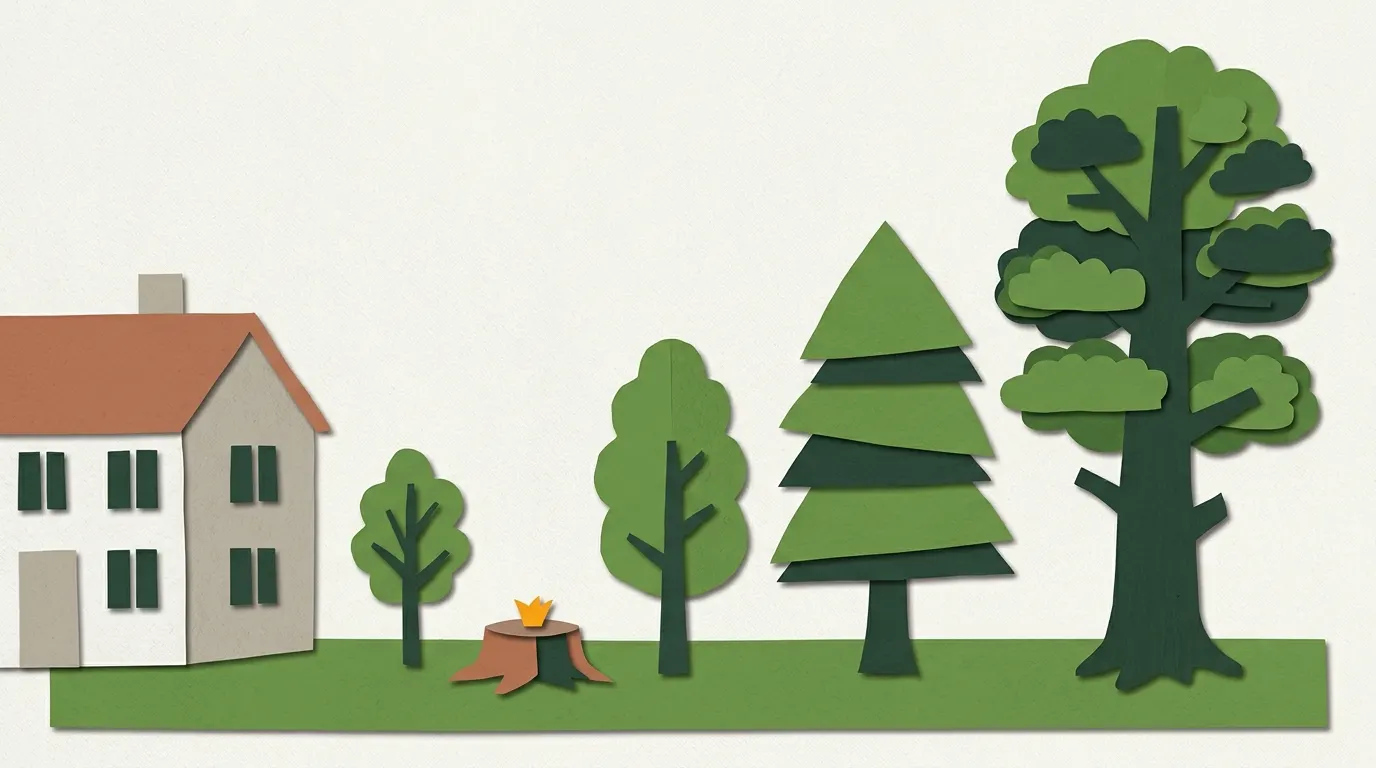
Our sources group trees into four bands: under 30 feet, 30–60 feet, 60–80 feet and over 80 feet. Pick the band that matches your tree's full height, not just the trunk. If you're unsure, compare the tree with your house: a two-story roofline is a handy yardstick. For a tree that sits right on a boundary between bands, run the calculator both ways and plan between the two results.
Number of trees
The calculator multiplies the per-tree price by the number of trees. Real quotes for several trees on one visit are often lower per tree, because the crew sets up and travels once. Our data doesn't measure that discount, so treat a multi-tree estimate as the upper side of what you might pay and ask each tree service for a single price on the whole job.
Near the house or power lines
A tree that could hit a roof, a fence or a line on the way down has to be lowered in sections with ropes instead of felled in one piece. In our data that adds 25–50% to the removal line. Only one source gives the figure, so the real surcharge may fall outside it. Trees touching power lines often need the utility involved first; ask your power company before you book anyone.
Stump grinding
Removal usually leaves the stump at ground level or a little above it. Grinding chews it down below the surface so you can plant grass over the spot. If you enter a trunk diameter, the calculator prices grinding at $2–$5.50 per inch, typical $3.75. Without a diameter, it uses $120–$450 per stump, typical $290. Our sources disagree widely on the per-stump figure, so measuring the trunk gives you a steadier number.
Trunk diameter
Diameter only affects stump grinding. None of our sources price the removal itself by trunk width, so a wide, short tree is priced the same as a slim one of the same height. If your tree has an unusually thick trunk, lean toward the high end of the range.
Haul-away
Some tree services leave the wood in rounds on your lawn unless you pay to have it taken away. In our data haul-away adds $70–$200 per job, and two of our sources treat it as included. That spread is wide, so ask every company whether the quote leaves the logs, the branches and the chips, or takes them.
Permit
The calculator includes a permit at $60–$150, typical $110, because many cities require one for larger trees. If yours doesn't, remove it from your budget. If the tree is dead or dangerous, ask your city whether a different rule applies.
Access and tree condition
A crew that can park next to the tree and drop it into an open lawn finishes faster than one carrying every branch through a side gate. Dead or rotten trees can also take more care to rig. Our data doesn't price access or condition separately, which is part of why the high number sits well above typical.
What the tree service cost calculator leaves out
The calculator prices full removal of standing trees. It doesn't cover trimming or pruning, removing a tree that has already fallen, emergency call-outs after a storm, root removal beyond grinding, or replanting. If your job includes any of these, the calculator's range won't match, and a tree service will price them separately. It also doesn't know about fences, sheds or gardens a crew has to work around. Mention those when you ask for quotes, because they change how a tree comes down.
Tree removal cost by state
Because tree work is mostly labor, local wages swing the price more than for most jobs. For one 30–60 ft tree, the typical price runs from $690 in Nebraska, $700 in Texas and $720 in Alabama to $1,130 in New Jersey, $1,170 in Oregon and $1,200 in Minnesota.
- Alabama$720
- Alaska$1,010
- Arizona$840
- Arkansas$770
- California$1,000
- Colorado$850
- Connecticut$820
- Delaware$820
- District of Columbia$890
- Florida$780
- Georgia$790
- Hawaii$930
- Idaho$750
- Illinois$1,030
- Indiana$780
- Iowa$740
- Kansas$810
- Kentucky$760
- Louisiana$800
- Maine$790
- Maryland$800
- Massachusetts$1,000
- Michigan$930
- Minnesota$1,200
- Mississippi$720
- Missouri$980
- Montana$960
- Nebraska$690
- Nevada$850
- New Hampshire$960
- New Jersey$1,130
- New Mexico$800
- New York$1,000
- North Carolina$810
- North Dakota$760
- Ohio$830
- Oklahoma$790
- Oregon$1,170
- Pennsylvania$940
- Rhode Island$980
- South Carolina$750
- South Dakota$840
- Tennessee$800
- Texas$700
- Utah$920
- Vermont$990
- Virginia$820
- Washington$1,020
- West Virginia$820
- Wisconsin$930
- Wyoming$780
Ways to lower the cost
- Bundle the trees. If more than one tree needs to go, get them quoted together so the crew sets up and travels once.
- Keep the wood. Ask for the price with and without haul-away; if you burn firewood or have a neighbor who does, the logs can stay.
- Skip the grinding for now. A stump can be ground later; just ask whether a second visit carries its own trip charge.
- Clear the area. Move cars, furniture and planters out of the drop zone before the crew arrives so they spend their hours on the tree.
- Ask about timing. If the tree isn't urgent, ask each tree service whether a slower season would change the price.
- Ask the utility first. For a tree near power lines, the utility may handle the part near the lines.
Hiring tips
Get at least three written quotes for the same work: the same trees, the same height, and the same decisions on stump grinding, haul-away and cleanup. Ask each company to list those as separate lines and compare them with the breakdown above. A quote far below our low number deserves questions about insurance and what's left on your lawn afterward.
Ask whether an arborist, a specialist trained in tree care, will look at the tree, especially if it leans, has dead limbs or stands near the house. Ask for proof of liability insurance and coverage for workers, and check that the company has a license where your state or city requires one. Get the start date, the payment schedule and the cleanup plan in writing, including what happens to ruts in the lawn. I'd also ask who applies for the permit and whether the fee is already in the price. Bring the ballpark. Ask for the line items.