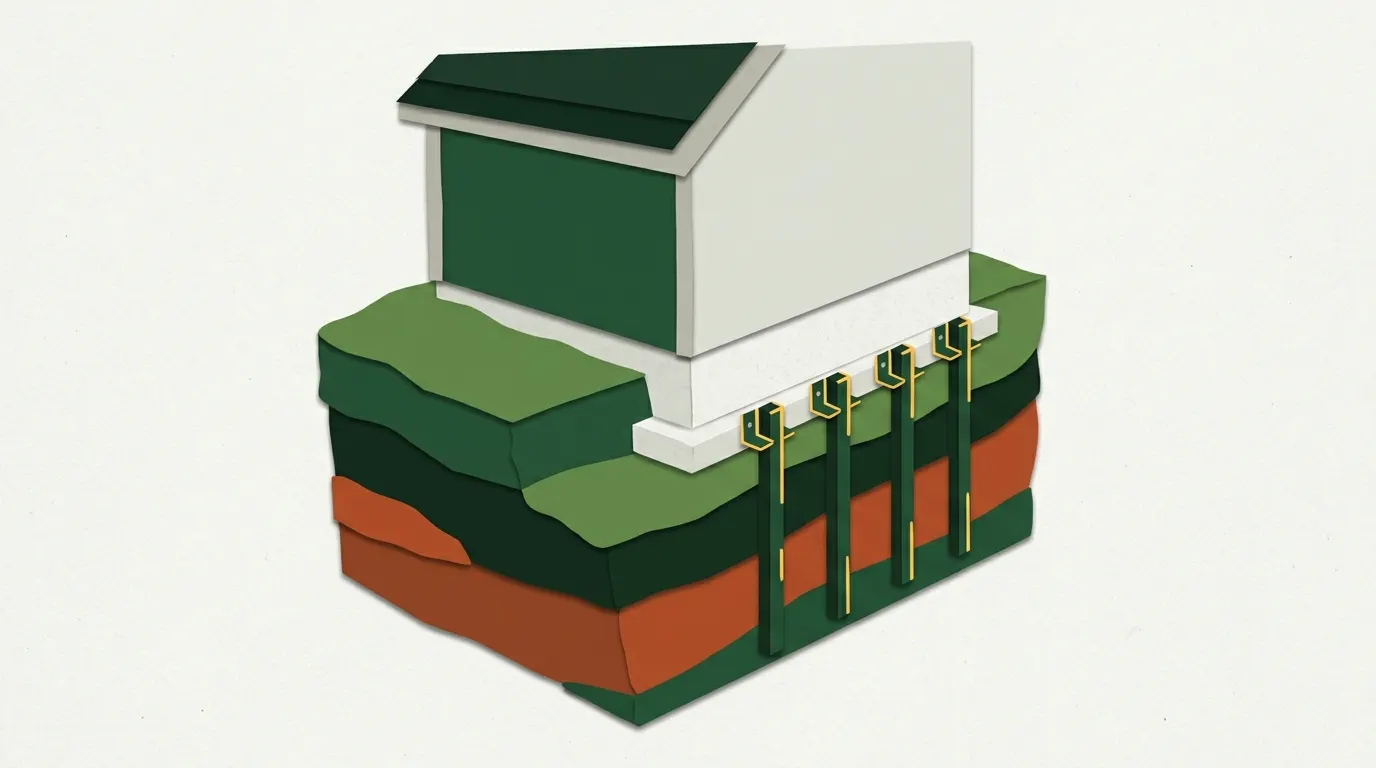
National ballpark · stabilizing a settling foundation with 6 piers
This is a planning range, not a quote.
Limited data: structural engineer inspection (sources disagree); foundation repair permit (one source). The real range may be wider.
| Cost | Low | Typical | High |
|---|---|---|---|
| Materials | $3,000 | $4,880 | $6,750 |
| Labor | $3,000 | $4,880 | $6,750 |
| Structural engineer inspection | $300 | $1,200 | $1,200 |
| Permit (varies by city) national | $75 | $110 | $150 |
| Total | $6,380 | $11,100 | $14,900 |
How this foundation repair cost calculator works
Enter your ZIP code, the kind of problem and, for settling, the number of piers. The calculator takes a national price for that repair, or multiplies the price per pier by your count, then adds a structural engineer's inspection and the permit. It adjusts the repair part for wages and prices in your state.
You get three numbers. Low fits a small, easy-to-reach repair. Typical is where most quotes land. High covers deeper piers, harder access, more damage and busy markets. The breakdown splits the bill into materials, labor, the engineer's inspection and the permit, so you can compare it line by line with a contractor's quote.
None of our sources states how foundation repair splits between materials and labor, so the calculator assumes half and half. The state adjustment uses construction wages from the Bureau of Labor Statistics for the labor half and regional price levels from the Bureau of Economic Analysis for the materials half. The permit stays national, because cities set it. The full method is on our How we calculate page.
Foundation repair cost by problem
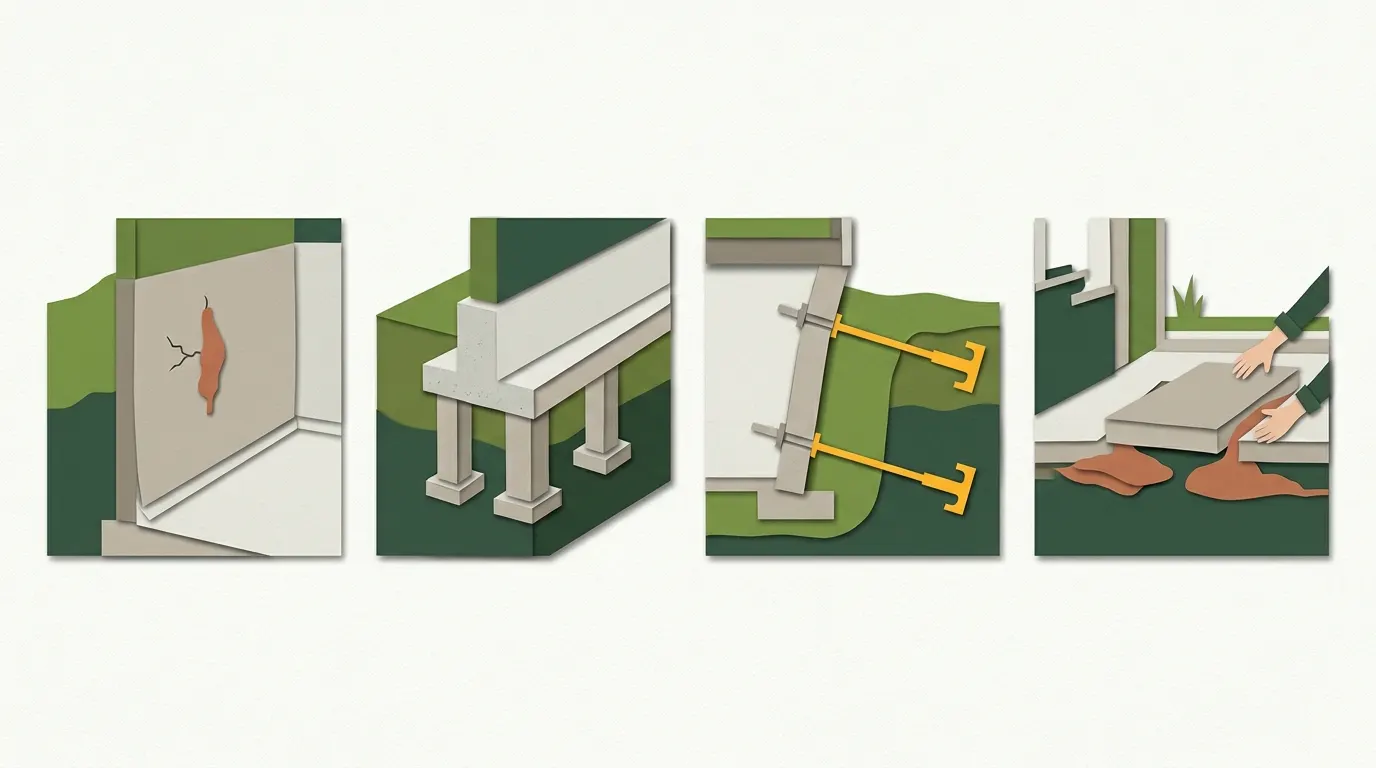
The problem you're fixing sets the price more than anything else. Here's what each option in the form means:
- Cracks: sealing or injecting cracks in a foundation wall or slab.
- Settling (piers): steel or concrete piers placed under the footing to hold the house on firmer soil.
- Bowing walls: anchors, straps or braces that hold a basement wall that's leaning inward.
- Slab leveling: lifting a sunken concrete slab by pumping material beneath it.
| Option | Low | Typical | High | Unit |
|---|---|---|---|---|
| Bowing walls * | $3,750 | $6,060 | $8,380 | project |
| Cracks | $200 | $600 | $1,000 | project |
| Settling (piers) | $8,630 | $10,000 | $31,300 | project |
| Slab leveling * | $550 | $1,500 | $1,500 | project |
* Limited data: one source, sources that disagree widely, or a single figure.
These are whole-job prices from our sources. For settling, the calculator works differently: it multiplies a per-pier price by your count instead of using the job total, because the job totals don't say how many piers they include. That's why the 6-pier default of $6,380–$14,900 is lower than the $8,630–$31,300 job range in the table. Bowing walls and slab leveling carry a wide spread between sources, so treat those ranges as limited data.
What affects the cost of foundation repair
Type of problem
For the same house, the typical price runs from $1,910 for crack repair and $2,810 for slab leveling to $7,380 for bowing walls and $11,100 for pier work with 6 piers. Each figure includes the inspection and permit.
Number of piers
Each pier runs $1,000–$2,250 installed, typical $1,630, in our two sources. The count depends on how much of the house is moving and how far apart the piers need to be. Pier type matters too: in one source, a full hydraulic pier job runs $8,000–$30,000 and a helical pier job $10,000–$30,000. Ask why a contractor chose the type and count they quote.
Method for bowing walls
The fix for a leaning wall depends on how far it has moved. One source prices wall anchors at $80–$150 per linear foot of wall, steel or carbon fiber straps at $85–$280, and helical tiebacks at $300–$360. Straightening a wall that has moved a lot runs $340–$550 per linear foot in the same source. A contractor working from a list of anchors may quote per anchor instead: one prices them at $830–$1,000 each.
Slab size
Slab leveling depends on the area being lifted. Our sources put it at $3.50–$25 per square foot, depending on the method and the material pumped under the slab. A small walkway costs far less than a whole garage floor.
Engineer's inspection and soil report
A structural engineer's inspection runs $300–$1,200 in our data, typical $1,200, and our sources disagree widely on that price. Some repairs also call for a soil report, which runs $500–$3,000 in our data, typical $1,750. The calculator includes the inspection but not the soil report.
Access and extent
Piers under a deck, a porch or a finished basement take more digging and more restoration. Our data doesn't price these conditions separately, which is one reason the high end sits well above the typical price. Larger repairs exist too: one source puts lifting a whole house at $20,000–$30,000, and another puts major foundation repairs at $15,000–$100,000. The calculator doesn't cover those.
What the estimate doesn't cover
The estimate covers the repair, one engineer's inspection and the permit. It doesn't price these on their own:
- A soil report, if the engineer asks for one.
- Restoring finishes such as flooring, drywall, landscaping or a patio that has to come up for access.
- Drainage work like new gutters, downspouts or regrading. Our gutter installation cost calculator prices gutters.
- Waterproofing of a basement or crawl space.
- House lifting or a full foundation replacement.
Before you get quotes
A crack on its own doesn't tell you what a repair will cost or how soon you need one. What matters is the cause and whether the house is still moving, and that's hard to judge from inside. It helps to keep a simple record: dated photos of each crack with a tape measure beside it, plus notes on any doors or windows that have started to stick. If you're unsure what you're looking at, I'd get a structural engineer's assessment before choosing a repair, so the plan comes from someone who isn't selling the fix.
Foundation repair cost by state
Labor is about half of a foundation repair bill in our model, so local wages explain most of the gap between states. For 6 piers, the typical price runs from $9,640 in Arkansas and $9,680 in Alabama and Mississippi to $13,800 in Alaska and $15,300 in Hawaii.
- Alabama$9,680
- Alaska$13,800
- Arizona$10,900
- Arkansas$9,640
- California$12,400
- Colorado$11,200
- Connecticut$11,600
- Delaware$10,800
- District of Columbia$11,800
- Florida$10,400
- Georgia$10,000
- Hawaii$15,300
- Idaho$10,800
- Illinois$13,100
- Indiana$11,200
- Iowa$10,900
- Kansas$10,400
- Kentucky$10,400
- Louisiana$9,820
- Maine$10,800
- Maryland$10,900
- Massachusetts$12,300
- Michigan$11,100
- Minnesota$12,300
- Mississippi$9,680
- Missouri$11,600
- Montana$11,200
- Nebraska$10,400
- Nevada$11,200
- New Hampshire$11,000
- New Jersey$12,600
- New Mexico$9,970
- New York$12,300
- North Carolina$10,200
- North Dakota$11,000
- Ohio$11,500
- Oklahoma$9,730
- Oregon$12,100
- Pennsylvania$11,400
- Rhode Island$11,800
- South Carolina$10,300
- South Dakota$10,300
- Tennessee$10,300
- Texas$10,100
- Utah$10,800
- Vermont$11,200
- Virginia$10,600
- Washington$12,900
- West Virginia$10,400
- Wisconsin$11,600
- Wyoming$10,800
Ways to lower the cost
- Start with an engineer's report. A clear diagnosis keeps you from paying for a repair you don't need.
- Get quotes on the same plan. Give every contractor the engineer's report so they price the same piers or anchors.
- Fix drainage alongside the repair. Ask whether gutters, downspouts or grading near the house are part of the cause.
- Keep a record. Dated photos help an engineer see whether anything has changed, which can narrow the repair.
- Ask about the warranty. A transferable warranty can matter if you plan to sell.
Hiring tips
Get at least three written quotes based on the same engineer's report. Ask each contractor to list the method, the number and type of piers or anchors, excavation, restoration of landscaping or floors, the permit and the warranty as separate lines. Compare them with the breakdown above. A quote well above or below the rest deserves a question about what's different in the plan.
Ask who pulls the permit and whether the engineer will check the finished work. Get the timeline, payment schedule and warranty terms in writing, including whether the warranty transfers to a future owner. Check that the contractor holds a license where your state requires one, and ask for proof of insurance. Bring the ballpark. Ask for the line items.