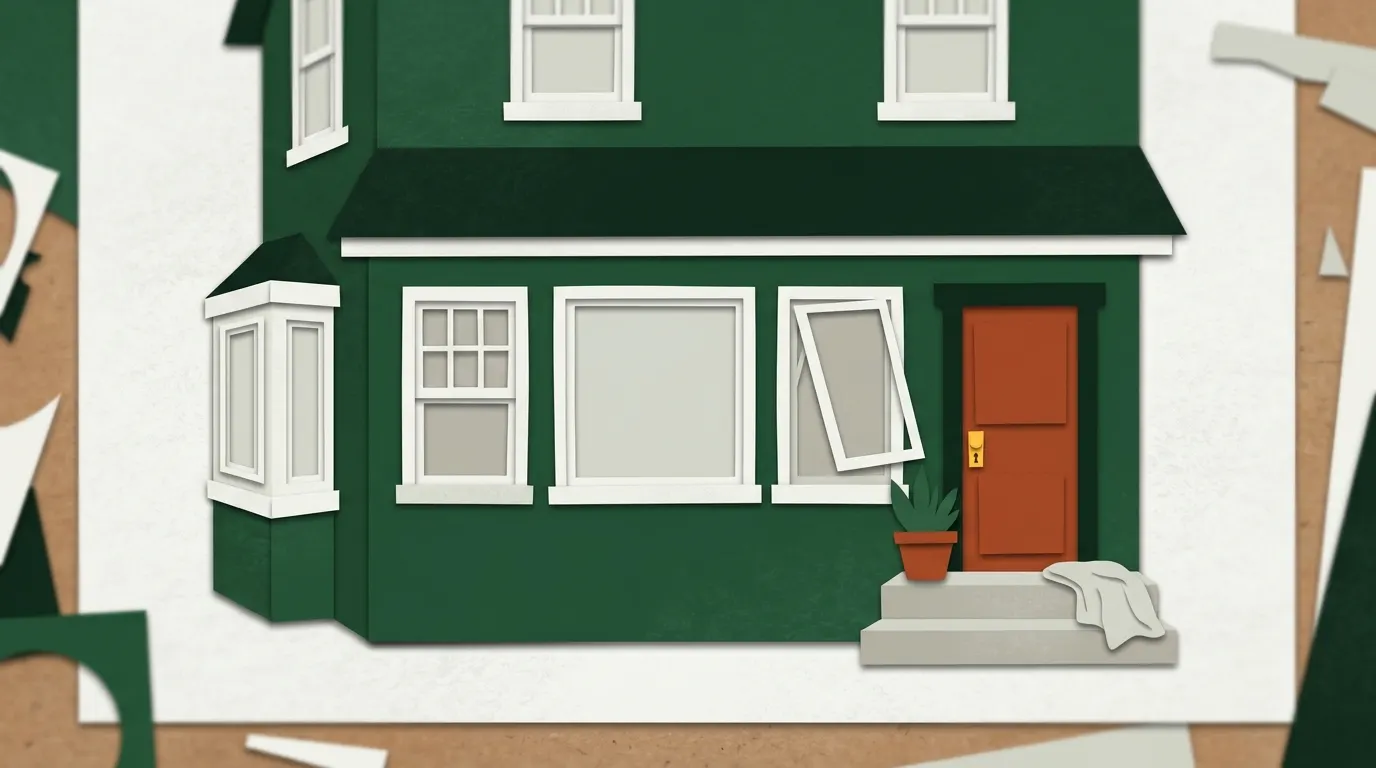
Windows are the part of a house you look through every day and think about least, until a sash sticks, the glass fogs or a draft shows up. Replacing them is one of the larger exterior jobs a homeowner takes on, and quotes can be hard to compare because every window is a bundle of choices. Doors are simpler, but a front door is the one part of the outside everybody touches. The calculators in this category start from national prices gathered from public cost guides, then adjusts them for wages and prices in your state.
You get a low, typical and high price, a breakdown that splits materials from labor, and a table of typical prices for all 50 states and DC. You don't need to leave an email to see the result.
Window replacement costs
The frame material sets the price of each window in our calculator. Installed, a vinyl window runs $380–$800, typical $470. Aluminum runs $200–$800, fiberglass $450–$1,400 and wood $540–$1,500. On 10 windows, that turns into $3,800–$8,300 for vinyl, $2,050–$8,300 for aluminum, $4,550–$14,300 for fiberglass and $5,490–$15,300 for wood. Each total includes a permit at $50–$300, a fee that comes from one source.
Window style and glass appear as reference prices beside the estimate. A double-hung window runs $370–$910 and a casement $430–$1,100, while double-pane glass sits at $380–$1,400 per window and triple pane at $610–$2,500. The window replacement cost calculator lets you set the count, frame, style, glass and installation type, and shows the typical price for every state.
Door replacement costs
Replacing one steel front entry door runs $600–$1,230 nationally, typical $920, installed. The breakdown splits it into the door and hardware, $470–$970 (typical $720), and installation, $130–$260 (typical $190). Material moves an entry door most: fiberglass runs $2,280–$3,530, typical $2,900. Our sources have no installed price for wood alone, so a wood front door uses the general front-door range, $550–$2,100, typical $1,350.
The type of door matters as much. Installed, an interior door runs $380–$740 (typical $560), a French door $1,050–$2,980 (typical $2,220) and a patio sliding door $1,010–$4,500 (typical $2,560). Our sources disagree widely on interior and patio sliding doors. Labor is only about 21% of a door bill, so the typical steel door runs from $830 in Oklahoma and Arkansas to $1,080 in Hawaii. The front door replacement cost calculator handles the count, door type and material.
What drives the price of window work
The frame. Vinyl and aluminum sit at the bottom on typical price, fiberglass and wood higher. The gap is widest at the top of the range, where custom sizes and premium wood or fiberglass lines live.
The count. Window jobs scale almost one for one with the number of windows. One source puts a whole single-story home at $8,000–$12,000 and a two-story home at $12,000–$24,000, but the count of openings tells you more than the size of the house.
Style and size. Fixed picture windows and simple sliders sit on the lower side of the style ranges; bay and bow windows sit far above, at $550–$6,250 installed. Larger and odd-shaped windows cost more in every style.
Glass. Double pane is the standard. Triple pane and safety glass add cost, and one source puts a tempered or laminated upgrade at $100–$800 per window.
Labor and access. Labor is about 30% of a window bill in our data, a modest share. Two sources put it at $150–$300 per window. Upper-floor windows, masonry walls and tight access raise it, though our sources don't put a number on those conditions.
The opening itself. An insert window fits inside the old frame; a full-frame job strips the opening to the framing. The second costs more and uncovers whatever damage the old frame was hiding.
How to budget a window project
Start with the typical number for your state and your frame material. Then ask where your house sits. Lean toward the low end if your windows are standard sizes, the frames are sound, and most openings are on the ground floor. Lean toward the high end if the house is older, if any sill feels soft, if you want wood or fiberglass, or if several windows are upstairs or oversized.
Next, decide whether every window needs replacing now. Because cost tracks the count closely, a two-stage plan is easy to price: run the calculator for the worst windows this year and the rest later. Some homeowners start with the side of the house that takes the most weather or the rooms they use most.
Then add a cushion for what's hidden. A full-frame replacement can reveal rot in the sill or framing, missing flashing or old water damage. Ask each installer how they price repairs to an opening, and get the rate in writing before work starts.
Think about timing as well. Custom windows are made to order and can take weeks to arrive, so the order date often sets the start date. If your schedule is flexible, ask each installer whether a slower season would change the price, and plan the work for weather when open walls won't let rain in.
Finally, line up quotes against the breakdown from our calculator. A quote that leaves out disposal of the old windows, interior trim or the permit can look cheaper than it is.
Repair or replace?
Not every tired window needs a full replacement. If the glass is broken or the seal between panes has failed but the frame and sash are sound, replacing only the glass costs $280–$350 per window, typical $320, in one source. A sticking sash, a worn weatherstrip or a broken balance (the spring or cord that holds a double-hung sash in place) can often be repaired for less than a new window, though our data doesn't price those repairs.
Replacement makes more sense when frames are rotted, cracked or warped, when several windows have the same problem, or when you want a different style or frame material. A contractor who offers both repair and replacement can tell you which windows fall into which group.
Planning windows with other exterior work
Windows connect to the walls, the trim and the roof line, so timing matters. If you plan new siding, replacing windows at the same time lets the crew flash and trim each opening once; the siding cost calculator prices that side of the job. If the roof is due, it usually goes first, so roofers working above don't damage new glass. More exterior jobs are on the Roof & Exterior page.
Questions to ask a window installer
- Insert or full-frame? Ask which method they plan for each window and why.
- Who measures and orders? Find out who pays if a custom window arrives the wrong size.
- What's in the price? Removal and disposal of the old windows, interior and exterior trim, caulking and cleanup are the lines most often left out.
- How will each opening be sealed? Ask about flashing, insulation around the frame and the exterior sealant.
- What warranty applies? The window maker's warranty and the installer's labor warranty are often separate.
- Who handles the permit? Ask who applies, who pays and whether the fee is in the quote.
- Are you licensed and insured? Ask for proof of insurance, and check licensing where your state requires it.
Reading a window quote
A clear quote lists every window by location, size, style, frame material and glass, then the installation method, labor, trim, disposal and permit. That way you can match each line against your own list and against our calculator's breakdown.
If two quotes differ a lot, look first at the product lines. One installer may be pricing a builder-grade vinyl window and another a premium fiberglass one. A quote far below our low number often leaves something out; one far above our high number may reflect custom sizes or repairs the installer saw and we can't. Bring the ballpark. Ask for the line items.