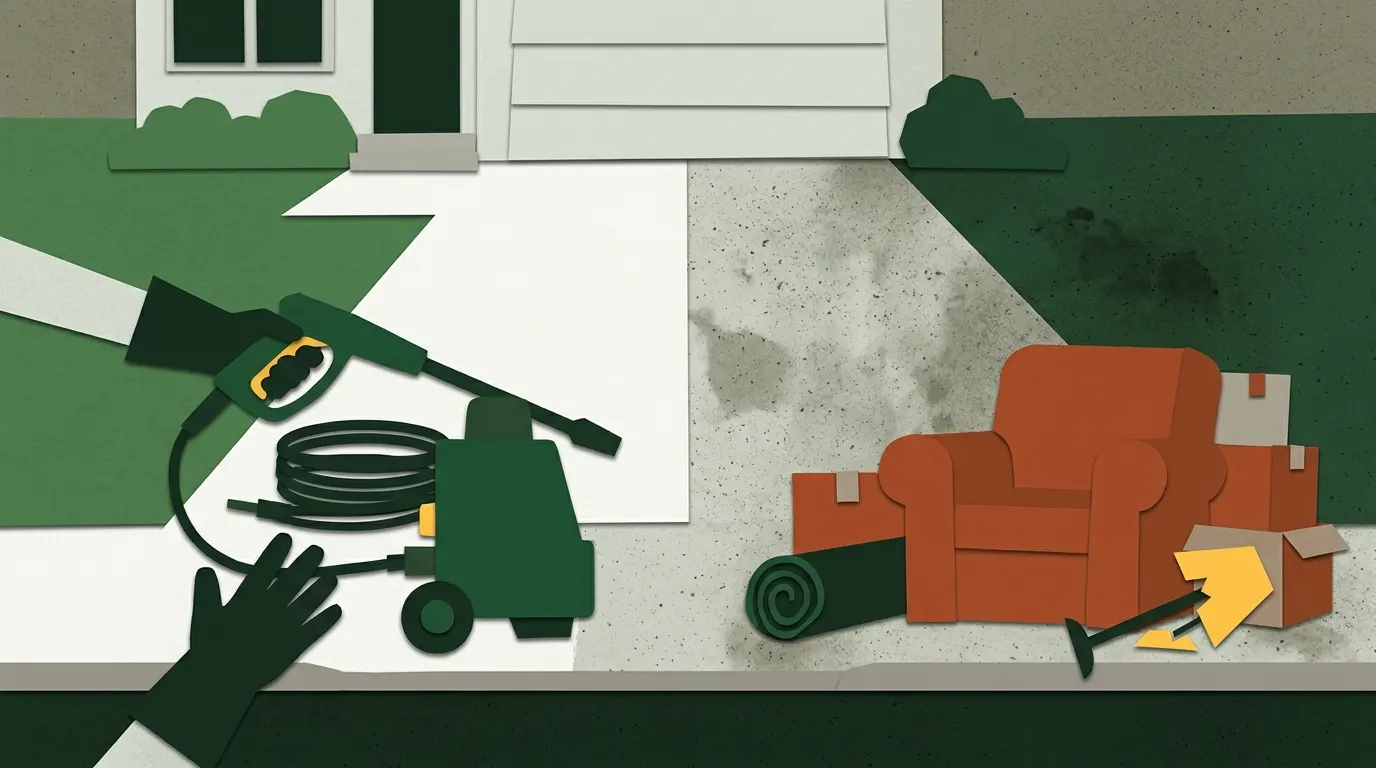
Cleanup jobs look simple, and that's exactly why their prices are easy to misjudge. A junk hauler's bill depends on how much of the truck your pile fills, not on how long it took you to collect it. A pressure washing bill depends on the surface and the square footage, plus a minimum fee that catches small jobs. The calculators in this category start from national prices gathered from public cost guides, then adjust them for wages and prices in your state.
Every calculator gives you a low, typical and high price, a breakdown you can hold next to a company's quote, and a table of typical prices for all 50 states and DC. You don't need to leave an email to see the result.
Junk removal costs
Haulers price by volume. A single bulky item runs $75–$180, typical $120. A quarter truckload costs $140–$280, typical $160, and a half truckload $250–$450, typical $380. A full truck runs $600–$800, typical $680. Five or six of our sources price each of these sizes, so they're among the better-supported numbers on the site.
The price usually covers the crew, the truck and the dump fee in one line. None of our sources split that into labor and disposal, so our calculator doesn't either. Extras can come on top: one source prices extra labor for stairs or a long carry at $50–$150, and another puts a load of construction debris at $300–$800. Light demolition, such as taking apart a hot tub or a play set before hauling it, has no reliable national price in our data, so the calculator says so instead of estimating. Tearing down a whole structure is priced: the demolition cost calculator puts a shed at $500–$2,000 and a 1,500 sq ft house at $6,050–$24,300.
The junk removal cost calculator handles single items and truck loads, and lets you enter more than one.
Pressure washing costs
The surface sets the rate per square foot. A concrete driveway runs $0.20–$0.40, house siding $0.25–$0.45 and a soft-washed roof $0.30–$0.75. For 1,500 sq ft, that works out to $300–$600 for a driveway, $380–$680 for siding and $450–$1,130 for a roof. Decks are priced per job instead, at $100–$350, typical $150, because sources disagree widely on per-foot deck prices.
Most companies also charge a minimum job fee. One source puts it at $100–$350, typical $100, and the calculator never shows less than that. Roof prices in our calculator cover only soft washing, the low-pressure method with a cleaning solution, because high pressure can damage shingles.
The pressure washing cost calculator prices siding, driveways and roofs by the square foot and decks per job.
What drives cleanup costs
Volume and area. Junk removal grows with how much of the truck you fill, and pressure washing grows with square footage. Both are easy to measure before you call, and both make quotes easier to compare.
Labor share. Pressure washing is almost all labor: the crew's time costs far more than the water and the cleaner. That's why local wages swing the price between states more for washing than for hauling. Junk removal also carries landfill and fuel costs, and its prices change less from state to state.
Minimum fees. Both trades have them. A truck rolling out for one chair, or a crew setting up for a small patio, still costs the company a trip. Small jobs often land at the minimum rather than at the per-item or per-foot price.
Access. Junk on the third floor costs more to remove than junk in the garage. A second-story wall takes longer to wash than one you can reach from the ground. Clear paths, open gates and a parking spot near the work keep the bill near the low end.
What's in the job. Construction debris is heavier and costs more to dump than household junk. Heavy mildew, oil stains and rust take longer to wash off than everyday dirt. Our calculators price the standard job, so expect quotes for tough material to run toward the high end.
How to budget a cleanup job
Start with the typical number for your state, then decide which side of it you're on. Lean toward the low end if everything is easy to reach, the job is ordinary and your timing is flexible. Lean toward the high end if the junk is upstairs or heavy, if the surface hasn't been cleaned in years, or if the job needs extra prep.
Then check the minimum. A small job may cost the minimum fee no matter what the per-foot or per-item math says. If you're close to it, think about adding a second item or a second surface to the same visit.
Combine work where you can. One full truckload costs less than two half loads picked up on separate days, and one pressure washing visit that covers the siding and the driveway saves a second setup. Running the calculator twice, once for each piece and once for the whole job, shows you what bundling is worth.
When you compare quotes, line them up against our breakdown. A quote that seems cheap may leave out stairs, a debris surcharge or stain pre-treatment.
Planning more than one cleanup
If junk removal and pressure washing are both on your list, haul first and wash second. Clearing the garage, the side yard and the driveway gives the washing crew room to work, and you won't track debris across a fresh surface. If you're also planning a remodel, wait to book the final haul until the work is done, so the leftover materials go out in the same load.
Questions to ask a cleanup company
- What does the price include? For hauling: loading, sweeping up and disposal. For washing: which surfaces, which method and any stain treatment.
- How do you measure the job? Ask how a hauler judges load size and how a washer measures square footage.
- Is there a minimum charge? Find out the floor before you book a small job.
- What costs extra? Stairs, heavy items, mattresses, construction debris, heavy mildew and second-story walls are common add-ons.
- Where does the junk go? Ask whether usable items are donated or recycled.
- Are you insured? Ask for proof of liability insurance, and check licensing where your state requires it.
Reading a cleanup quote
A good quote names the job in pieces you can check. For junk removal, that's the load size or item count, any extra charges and whether disposal is included. For pressure washing, that's each surface, its square footage, the method and any pre-treatment.
Hold each piece next to our calculator's result. Big gaps aren't proof of a bad quote, but they're the right place to ask questions. A price far below our low number often means something is left out; a price far above the high number may reflect access or grime the company saw and we can't.
Before the crew arrives
Sort what goes and what stays, and mark it clearly, so nothing you meant to keep ends up in the truck. Close windows, cover outlets and move furniture, planters and cars away from surfaces being washed. Check your HOA or city rules if a dumpster or a truck will sit on the street. Bring the ballpark. Ask for the line items.