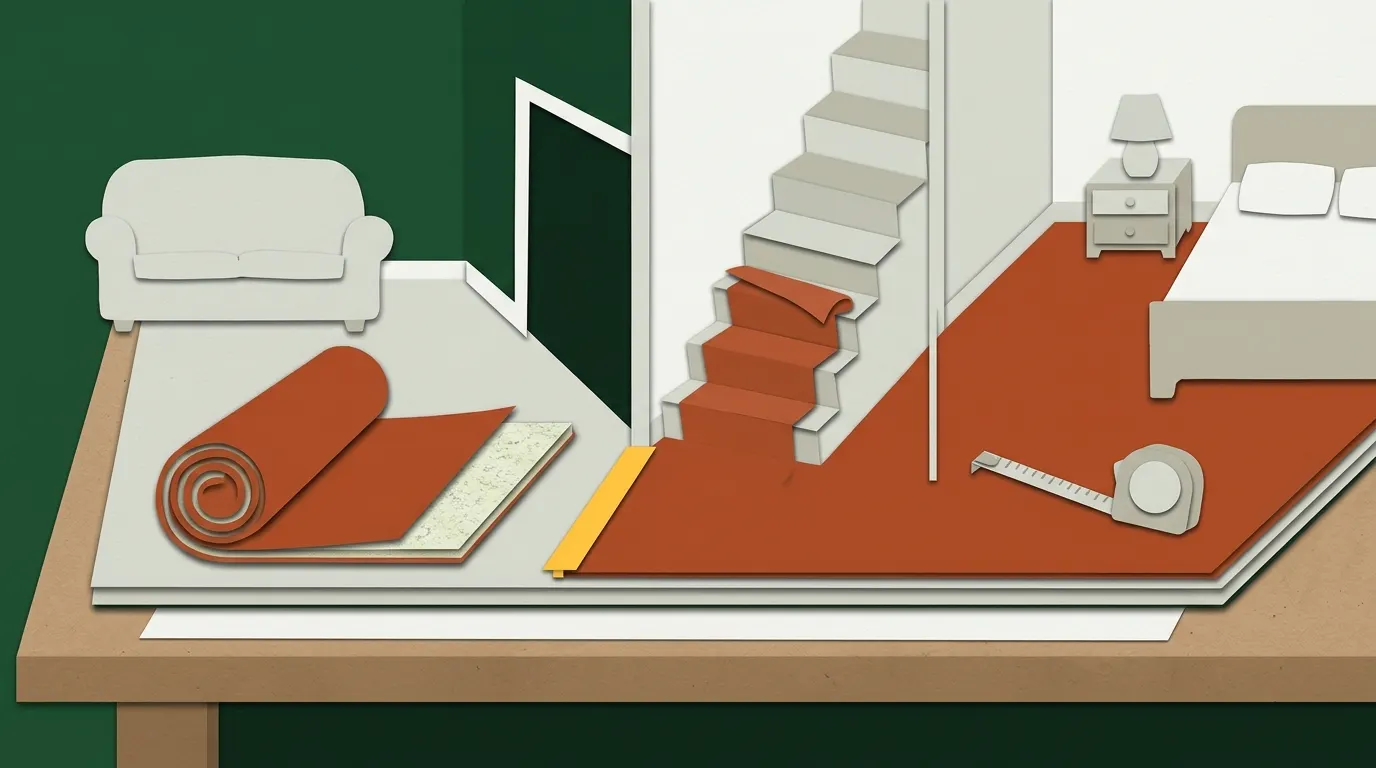
A new floor is one of the few home projects you can measure yourself with a tape in ten minutes, which makes it a good place to check a quote. Most of the price comes from the area, the material grade and what has to come up first. The calculators in this category start from national prices gathered from public cost guides, then adjust them for wages and prices in your state.
Every calculator gives you a low, typical and high price, a breakdown you can hold next to an installer's quote, and a table of typical prices for all 50 states and DC. You don't need to leave an email to see the result.
Carpet installation costs
Installed with pad, carpet runs $3–$11 per square foot, typical $7.47, from five sources. For 500 sq ft of mid-range carpet, that comes to $1,500–$5,500, typical $3,740. The breakdown splits it into carpet and pad, $1,170–$4,290 (typical $2,910), and labor, $330–$1,210 (typical $820).
Grade decides most of the bill. Before installation, budget carpet runs $2–$3 per square foot, mid-range $2–$5 and premium $4–$20, all from one source. On 500 sq ft, budget carpet costs $1,170–$4,270 (typical $2,900) and premium $4,340–$15,900 (typical $10,800). Labor stays about the same for every grade, so the jump from mid-range to premium is almost all material.
The extras add up. Removing old carpet adds $1.19–$2.49 per square foot, typical $1.84, and stairs add $11–$26 per step, typical $19. The carpet installation cost calculator handles area, grade, pad, removal and stairs.
Laminate, vinyl plank and hardwood costs
Installing 500 sq ft of laminate runs $2,500–$6,000 nationally, typical $4,250. Installed, laminate runs $5–$12 per square foot, typical $8.50. The material moves the price most: on the same 500 sq ft, luxury vinyl plank is typical $3,880, epoxy $3,750, engineered hardwood $5,750 and solid hardwood $8,500, with solid hardwood running $9–$25 per square foot installed.
Two extras are inputs. Removing the old floor takes the laminate example to $3,000–$8,000, typical $4,750, and subfloor repair to $3,500–$9,500, typical $6,500. The flooring cost calculator handles five materials, and the laminate flooring cost calculator starts with laminate already selected.
Tile installation costs
Installing 200 sq ft of porcelain floor tile runs $1,800–$4,040, typical $2,920. Where the tile goes sets the rate: floor tile runs $9–$20 per square foot installed (typical $15), wall tile $11–$22, shower tile $22–$30 and backsplash $25–$50. The same 200 sq ft is typical $4,400 on a wall and $5,210 in a shower. Our sources disagree widely on floor tile per square foot, so expect a limited-data note. The tile you pick is shown as a reference price, porcelain at $14–$40 per square foot installed, and the laying pattern isn't priced separately. Use the tile installation cost calculator.
What drives the price of a new floor
Area. Flooring is priced by the square foot, so area is the starting point of every quote. Rolls and boxes come in fixed sizes, though, and installers order extra for cuts, seams and waste. Odd-shaped rooms waste more than square ones.
Material and grade. Within one material, grade can move the price by several times. For carpet, the typical material price goes from $2.50 per square foot for budget to $12 for premium. Ask what grade each quote is for before you compare totals.
Labor share. Carpet is about 22% labor in our data, so most of the bill is material. Laminate, hardwood and tile take more cutting and fitting, at about 48% labor, which makes the state you live in matter more.
Tear-out. Something has to come up before the new floor goes down. Old carpet is the easiest; glued carpet takes longer, and one source adds $0.33–$0.56 per square foot for glued-down removal.
Stairs. Each step is cut and fitted by hand. That's why stairs are priced per step rather than per square foot.
The subfloor. The plywood or concrete under the old floor may need repair, leveling or a fix for squeaks. The flooring cost calculator has a subfloor repair line; the carpet and tile calculators don't price it, and the need often only shows up once the old floor is gone.
Transitions and furniture. Strips where one floor meets another cost $15–$50 each in one source, typical $33. Moving furniture out and back runs $100–$200 for the job, typical $150, also from one source.
How to budget a flooring project
Start with the typical number for your state, then decide which side of it you're on. Lean toward the low end if your rooms are square and empty, the old floor is easy to remove and you're happy with a basic grade. Lean toward the high end if you want a premium grade, if the rooms have many corners and closets, or if the subfloor is in doubt.
Then add the pieces your project actually has. Removal, stairs, transitions and furniture moving each show up as a separate line in a good quote, and together they can add several hundred dollars to a few rooms. Running the calculator twice, once with removal and once without, shows you what that line is worth.
Add a cushion for the subfloor. If you find soft spots, stains from an old leak or loose boards when the old floor comes up, the installer will want to fix them first, and only the flooring cost calculator includes that work. Ask each installer how they price subfloor repair and put the answer in writing.
When you compare quotes, line them up against the breakdown from our calculator. A quote that leaves out pad, removal or stairs may look cheaper than it is.
Measuring before you call
Measure each room at its longest and widest points, wall to wall, and multiply the two. Add closets, hallways and any nook that gets the same floor. Split L-shaped rooms into two rectangles. Count stairs separately, by the number of steps.
Write the numbers down room by room. When you ask for quotes, give every installer the same list, so each one prices the same job. Installers will measure again before they order, and that's fine. Your own numbers tell you if theirs are way off. A quote that's measured at much more than your area isn't proof of a problem, because of waste, but it's worth asking how they got there.
Planning more than one room
If you're doing several rooms, doing them at once usually costs less per square foot than one at a time. The crew comes once, the material comes off the same roll or lot, and the transitions between rooms can be planned together.
The order of projects matters too. Painting usually goes before new carpet, because paint drips are easier to clean off a bare floor than out of new pile. Drywall repairs, new baseboards and anything else that creates dust are best done before the new floor goes in.
Questions to ask a flooring installer
- What exactly is included? Pad, removal of the old floor, haul-away, transitions and furniture moving are the lines most often left out.
- What grade and product is this? Get the exact product name on paper, so two quotes for "mid-range carpet" can be compared.
- Where will the seams go? A seam in a doorway is less visible than one across the middle of a room.
- What happens if the subfloor needs work? Get the price for repair, if any, written into the quote.
- What does the labor warranty cover, and for how long? Ask what's covered if the floor ripples, lifts or separates.
- Are you licensed and insured? Ask for proof of insurance, and check licensing where your state requires it.
Reading a flooring quote
A good quote lists the job in pieces you can check: the area of each room, the product and grade, the pad, removal and disposal, stairs, transitions and any subfloor work. Hold each piece next to the breakdown from our calculator. Big gaps aren't proof of a bad quote, but they're the right place to ask questions. A price far below our low number often means something is missing; a price far above the high number may reflect a room the installer saw and we can't.
Watch for quotes that bundle everything into one line per room. You can't compare those with another quote or with our range, so ask for a breakdown. Bring the ballpark. Ask for the line items.