National ballpark · a mid-range renovation of a 2,000 sq ft house
This is a planning range, not a quote.
| Cost | Low | Typical | High |
|---|---|---|---|
| Materials | $50,000 | $60,000 | $115,000 |
| Labor | $50,000 | $60,000 | $115,000 |
| Permit (varies by city) national | $500 | $1,500 | $2,500 |
| Total | $100,500 | $121,500 | $232,500 |
How this home renovation cost calculator works
Enter your ZIP code, the area you're renovating in square feet, the scope of the work and whether it covers the whole house or select rooms. The calculator multiplies your area by a price per square foot for that scope, adds the building permit, then adjusts the result for wages and prices in your state.
You get three numbers. Low fits plain materials, an easy house and a clear plan. Typical is where most quotes land. High covers older homes, premium finishes and plans that move walls. The breakdown splits the bill into materials, labor and the permit, so you can compare it line by line with a contractor's quote.
None of our sources states how a renovation bill splits between materials and labor, so the calculator assumes about half and half. The state adjustment uses construction wages from the Bureau of Labor Statistics for the labor half and regional price levels from the Bureau of Economic Analysis for the materials half. Permit fees stay national, because cities set them. The full method is on our How we calculate page.
Home renovation cost by scope
Scope means how deep the work goes, and it changes the price per square foot more than anything else in the form.
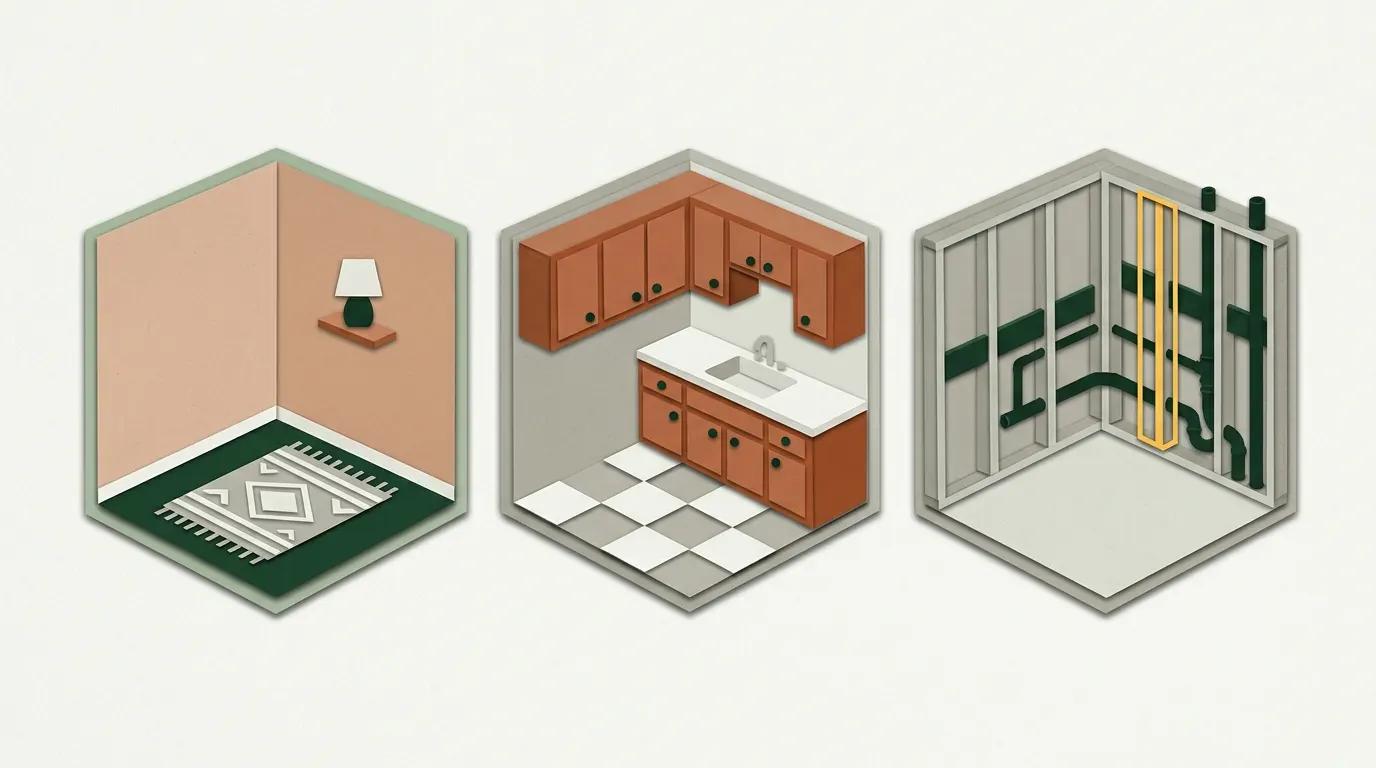
- Cosmetic is a refresh: paint, flooring, light fixtures, hardware and maybe new counters, with the layout left as is.
- Mid-range replaces the kitchen and bathrooms, flooring and finishes, and may update some wiring and plumbing.
- Full gut strips the house to the studs and rebuilds the interior, usually with new wiring, plumbing and insulation.
| Option | Low | Typical | High | Unit |
|---|---|---|---|---|
| Cosmetic | $15 | $15 | $53 | /sq ft |
| Full gut * | $120 | $160 | $210 | /sq ft |
| Mid-range | $50 | $60 | $120 | /sq ft |
* Limited data: one source, sources that disagree widely, or a single figure.
For a cosmetic refresh, the typical rate sits at the bottom of the range, because our sources' usual figure for this kind of job is the same as their low. That's why the calculator shows a 2,000 sq ft cosmetic job at $30,500–$107,500 with a typical price of only $31,500. The full-gut rate rests on one source after we removed a figure that didn't match the page it came from, so treat that range as limited data.
What affects the cost of a home renovation
Scope
Scope sets the rate. For a 2,000 sq ft house the typical price runs from $31,500 for a cosmetic refresh to $121,500 for a mid-range remodel and $329,000 for a full gut. The jump to a full gut is large because the house is effectively rebuilt inside: demolition, new systems, new walls and all-new finishes.
Area
The calculator multiplies the rate by the area you enter, so area matters as much as scope. If you're not touching the whole house, enter only the rooms you're working on. A finished basement or an attic room counts if it's part of the work.
Kitchens and bathrooms
These are the most expensive rooms per square foot, because they bring cabinets, counters, fixtures, plumbing and tile together. One source puts a mid-range kitchen at $40,000–$80,000, typical $60,000, and a full bathroom at $14,000–$50,000, typical $32,000. A house with two or three bathrooms will lean toward the high end for its size. For those rooms on their own, the kitchen remodel cost calculator and the bathroom remodel cost calculator go deeper.
Demolition and disposal
Tearing out old finishes and hauling them away runs $6,000–$20,000 in one source, typical $13,000. That's built into the per-square-foot rates, but it's worth seeing as its own line on a quote, since it grows quickly in a full gut.
Age and condition of the house
Older houses can hide water damage, outdated wiring, old plumbing or framing problems behind the walls. Our data doesn't price these surprises separately, which is one reason the high end sits well above the typical figure. If your house is old or hasn't been updated in decades, budget toward the high number.
Finish choices
Within any scope, your picks for cabinets, counters, flooring and fixtures move the bill. Stock cabinets and standard tile keep a mid-range job near the typical price. Custom cabinetry, stone and designer fixtures push it toward the high end.
What the estimate doesn't cover
The rates cover the work inside the house: demolition, materials, labor and finishes for the scope you pick. They don't price these on their own:
- Additions that add new floor area. Our home addition cost calculator covers those.
- Roofs, siding and windows, which have their own calculators.
- New furniture, appliances you buy yourself, and moving out while the work is done.
- Design and engineering fees if the plan moves bearing walls.
When to budget toward the high end
The typical figure assumes a house in fair shape, a clear plan and standard finishes. I'd plan nearer the high number if the house is old and hasn't been opened up before, if you're moving walls, the kitchen or bathrooms, if you want custom cabinets or stone, or if you live where remodeling contractors are booked months ahead. Changing your mind once the work starts also adds cost, so settle the finish list before the first quote.
Home renovation cost by state
Labor is about half of a renovation bill in our model, so local wages explain most of the gap between states. For a mid-range renovation of 2,000 sq ft, the typical price runs from $104,200 in Oklahoma and $104,900 in Arkansas to $142,000 in Illinois and $152,900 in Hawaii.
- Alabama$107,100
- Alaska$138,400
- Arizona$116,700
- Arkansas$104,900
- California$140,300
- Colorado$123,000
- Connecticut$123,400
- Delaware$117,800
- District of Columbia$126,500
- Florida$109,700
- Georgia$109,800
- Hawaii$152,900
- Idaho$110,800
- Illinois$142,000
- Indiana$121,100
- Iowa$114,900
- Kansas$114,400
- Kentucky$111,300
- Louisiana$107,200
- Maine$121,400
- Maryland$125,400
- Massachusetts$135,300
- Michigan$120,200
- Minnesota$126,100
- Mississippi$107,400
- Missouri$119,500
- Montana$117,400
- Nebraska$107,800
- Nevada$121,100
- New Hampshire$121,200
- New Jersey$129,200
- New Mexico$118,300
- New York$137,500
- North Carolina$108,100
- North Dakota$116,300
- Ohio$117,900
- Oklahoma$104,200
- Oregon$126,900
- Pennsylvania$119,900
- Rhode Island$120,000
- South Carolina$109,500
- South Dakota$106,500
- Tennessee$109,600
- Texas$108,800
- Utah$111,200
- Vermont$121,700
- Virginia$116,900
- Washington$137,600
- West Virginia$107,700
- Wisconsin$119,200
- Wyoming$115,100
Ways to lower the cost
- Keep the layout. Moving walls, plumbing and the kitchen sink adds trades and permits.
- Phase the work. Do the kitchen and bathrooms first, and the cosmetic rooms later.
- Repair what works. Refinishing floors or painting cabinets costs less than replacing them.
- Pick stock materials. Standard cabinet sizes and in-stock tile cost less and arrive sooner.
- Do the prep yourself if it's within your skills, such as moving furniture or painting, and ask each contractor what that saves.
- Hold a contingency. Set money aside for what's behind the walls before the first wall comes down.
Hiring tips
Get at least three written quotes for the same scope and finish list. Ask each contractor to price demolition, kitchen, bathrooms, flooring, electrical and plumbing work, and the permit as separate lines, then compare them with the breakdown above. A quote far below our low number deserves questions about allowances and what's left out.
Ask who pulls the permits and schedules inspections, and how change orders are priced if the crew finds problems behind the walls. Get the timeline, payment schedule and warranty in writing, and don't pay most of the bill up front. Check that the contractor holds a license where your state requires one, and ask for proof of insurance. Bring the ballpark. Ask for the line items.