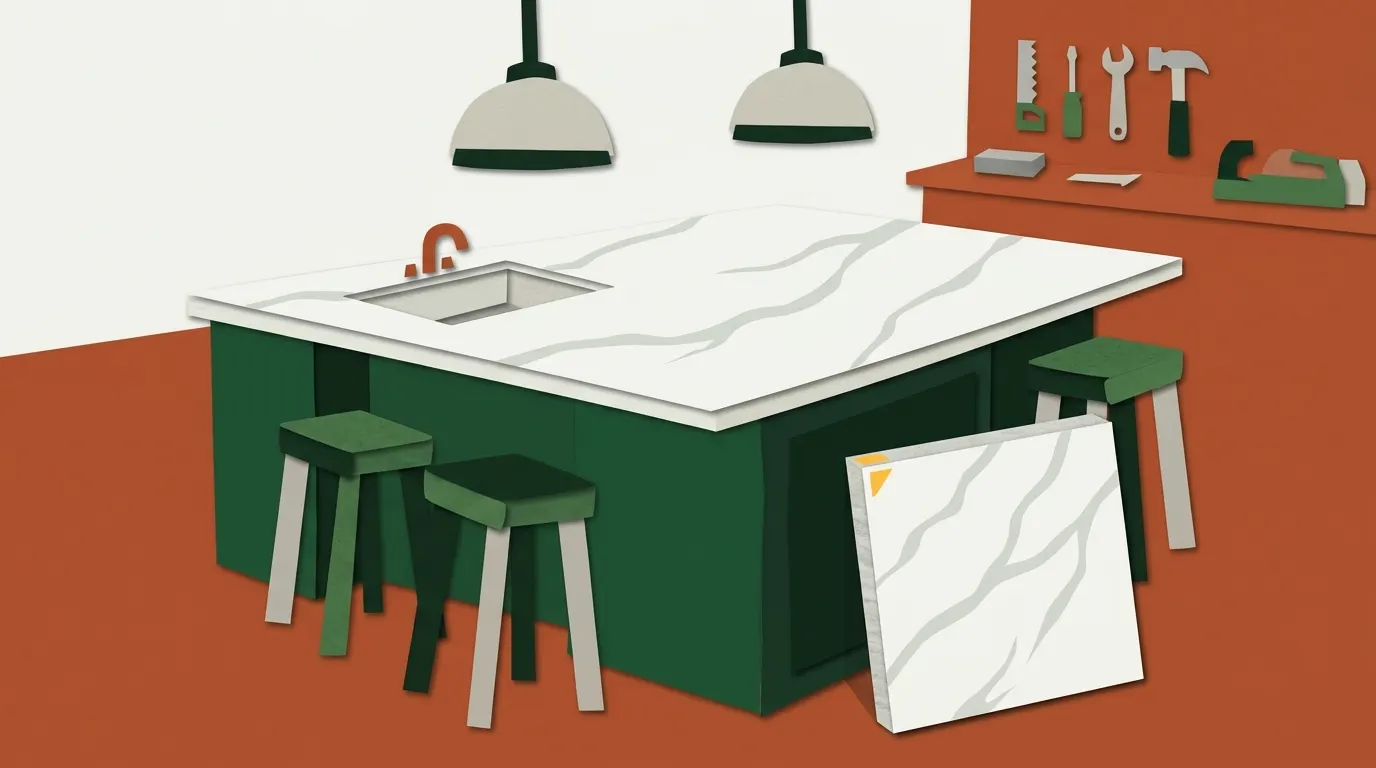
This page covers quartz countertops only. To compare quartz with granite, laminate, marble and other materials side by side, use the main countertop cost calculator. Quartz countertops are engineered stone: crushed natural quartz bound with resin and pigment, pressed into slabs at a factory, then cut to fit your cabinets.
National ballpark · 50 sq ft of quartz countertops with one sink cutout
This is a planning range, not a quote.
| Cost | Low | Typical | High |
|---|---|---|---|
| Materials | $2,000 | $4,890 | $7,890 |
| Labor | $600 | $1,460 | $2,360 |
| Total | $2,600 | $6,350 | $10,300 |
How the quartz countertop cost calculator works
The material is fixed to quartz here. Enter your ZIP code, the area of counter surface in square feet, the edge profile and the number of sink cutouts. The calculator multiplies the area by an installed quartz price per square foot, adds each cutout, shows a premium edge as a per-foot reference, and adjusts the total for your state.
On the 50 sq ft example, materials come to $2,000–$7,890, typical $4,890, and labor to $600–$2,360, typical $1,460. The split follows a labor share of about 23%. One of the sources behind that share looked at quartz on its own and gave a wider labor range than for countertops in general, which is one more reason to compare line by line. The method is on How we calculate.
Quartz countertop cost per square foot
Installed, quartz runs $50–$200 per square foot, typical $130. Five sources price it, and unlike granite and marble, quartz isn't flagged for wide disagreement. Its typical price is the highest of the six materials we track, so quartz rarely comes out as the cheap option, but its range is easier to trust.
| Option | Low | Typical | High | Unit |
|---|---|---|---|---|
| Butcher block * | $50 | $110 | $180 | /sq ft |
| Granite * | $55 | $110 | $160 | /sq ft |
| Laminate | $20 | $30 | $62 | /sq ft |
| Marble * | $53 | $100 | $200 | /sq ft |
| Quartz | $50 | $130 | $200 | /sq ft |
| Solid surface * | $45 | $85 | $130 | /sq ft |
* Limited data: one source, sources that disagree widely, or a single figure.
The spread from $50 to $200 is mostly the slab. Every maker sells several price groups. Plain whites and greys with a fine, even speckle sit at the bottom. Patterns that copy marble, with long veins that run across the slab, sit near the top, and unusual colors can cost more again.
Where quartz sits against the other materials
On 50 sq ft with one sink cutout, quartz has the highest typical price in our data:
- Quartz: $2,600–$10,300, typical $6,350
- Butcher block: $2,600–$9,000, typical $5,730
- Granite: $2,850–$8,230, typical $5,460
- Marble: $2,730–$10,300, typical $5,100
- Solid surface: $2,350–$6,500, typical $4,350
The bottom of the quartz range is no higher than granite's. A basic quartz slab in a plain color can come in under a basic granite slab. Where quartz pulls ahead is the typical and premium end. If you're torn between the two, ask for a quote on a plain quartz and a mid-grade granite for the same layout and compare them.
People pick quartz less for price than for its even look and lower upkeep. Because it's made in a factory, a slab looks the same from one end to the other, which makes seams easier to match. That matters on a long run or a large island where two slabs meet.
What affects the price
Slab color and pattern
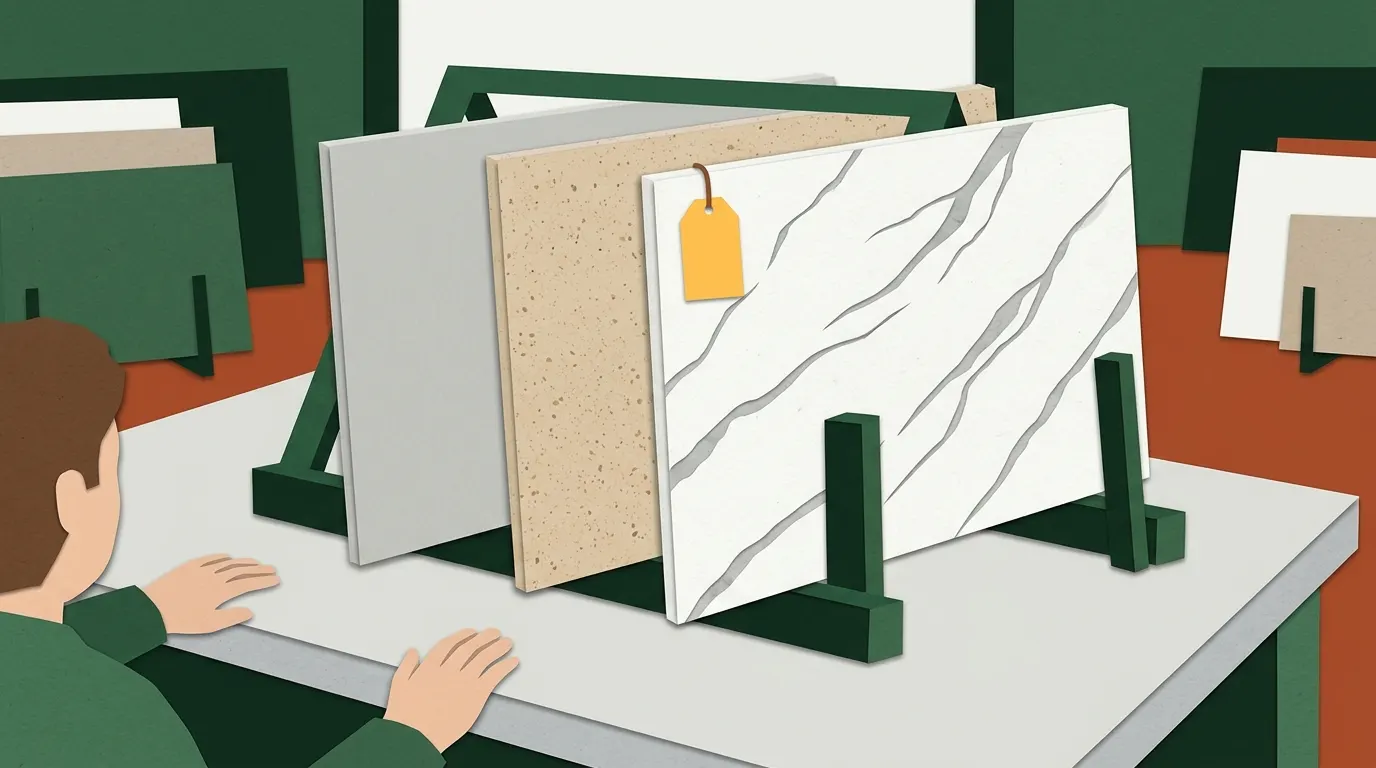
This is the largest swing on a quartz job. A plain slab lands near the low end, a veined marble look near the top. Seeing slabs in person helps: a small sample can't show where veins fall on a full slab.
Area and slab count
The calculator scales with area in a straight line. Quartz is sold by the slab, and slab sizes are fixed by the maker. A kitchen that needs just over one slab may pay for two, so the layout can matter more than a few square feet either way.
Thickness
Our data doesn't split quartz by thickness. Thicker slabs cost more per square foot and weigh more, so if you're quoted two thicknesses, compare them on the same layout.
Cutouts and edges
Each sink cutout adds $100–$250, typical $100. A premium edge runs $10–$20 per linear foot, typical $15, and the calculator shows it as a reference rather than adding it. Quartz takes a crisp, mitered edge well, where two pieces are cut at an angle to make a thick-looking front, but that's one of the costlier profiles.
Old countertop removal
Taking out the old top runs $50–$300 for the job, typical $180, and isn't in the calculator. Ask whether removal and disposal are in the quote.
Measuring a quartz job
Quartz is priced on the finished counter area, so sketch your layout first. Note each run's length along the wall, the depth, the island's length and width, and any overhang where stools tuck under. Mark the sink and the cooktop. A plain sketch like this lets every fabricator quote the same job, and it shows how many slabs the layout might need. The fabricator's own templating, done after the cabinets are set, is what the slab is cut to.
What the calculator leaves out
Some lines show up on quartz quotes that the calculator doesn't price. A full-height quartz backsplash uses more slab and more fitting. Waterfall ends, where the slab turns down the side of an island, need extra cuts and careful matching of the pattern. Plumbing disconnection, a new faucet and cabinet repair come from other trades. Ask each fabricator to list these separately, so the base price stays comparable with our range.
When the price lands near the top
Expect a quote near the high end of the range if you've picked a veined, marble-look slab, if your layout needs a second slab for only a small piece, or if you want mitered or waterfall edges. Long islands and tight access, such as a narrow stair to an upstairs kitchen, add handling time. If none of these apply, a quote far above the typical price deserves a question about what drove it.
Quartz countertop cost by state
Most of a quartz bill is material, so the gap between states is narrower than for labor-heavy jobs. For 50 sq ft with one sink cutout, the typical price runs from $5,630 in Oklahoma, $5,730 in Arizona and $5,740 in Mississippi to $7,000 in Alaska, $7,090 in Washington and $7,840 in Hawaii.
- Alabama$5,790
- Alaska$7,000
- Arizona$5,730
- Arkansas$5,740
- California$6,740
- Colorado$6,090
- Connecticut$6,570
- Delaware$6,110
- District of Columbia$6,760
- Florida$6,300
- Georgia$6,050
- Hawaii$7,840
- Idaho$6,160
- Illinois$6,960
- Indiana$5,840
- Iowa$6,090
- Kansas$6,060
- Kentucky$6,110
- Louisiana$5,770
- Maine$6,300
- Maryland$6,140
- Massachusetts$6,600
- Michigan$6,200
- Minnesota$6,450
- Mississippi$5,740
- Missouri$5,830
- Montana$6,250
- Nebraska$6,070
- Nevada$6,730
- New Hampshire$6,290
- New Jersey$6,920
- New Mexico$5,890
- New York$6,440
- North Carolina$6,070
- North Dakota$6,200
- Ohio$5,820
- Oklahoma$5,630
- Oregon$6,720
- Pennsylvania$6,360
- Rhode Island$6,340
- South Carolina$6,040
- South Dakota$6,080
- Tennessee$5,900
- Texas$5,960
- Utah$5,970
- Vermont$6,430
- Virginia$6,140
- Washington$7,090
- West Virginia$6,040
- Wisconsin$6,720
- Wyoming$6,090
Ways to lower the cost
- Choose a plain color. A simple white or grey from the maker's lowest price group can cut the slab cost sharply.
- Fit the layout to the slab. Ask the fabricator if a small change to an island or a return would save a second slab.
- Use quartz where it shows. A laundry or pantry counter can be laminate.
- Skip the mitered edge on runs nobody sees from the side.
- Ask about remnants for a bathroom vanity; a leftover piece in your color may be enough.
Hiring tips
Get at least three written quotes for the same quartz job: the same brand and color, price group, thickness, square footage, edge and cutouts. Two quotes for "white quartz" can mean very different slabs, so ask for the exact product on paper. Fabrication, installation, removal, cutouts and edge work should each be listed so you can check them against the breakdown above.
Ask to see your slab before it's cut, or a photo of it, and where the seams will fall. Ask whether the warranty comes from the maker, the fabricator or both, and what voids it. Confirm who disconnects and reconnects the sink. Ask for proof of insurance, and check licensing where your state requires it. Bring the ballpark. Ask for the line items.