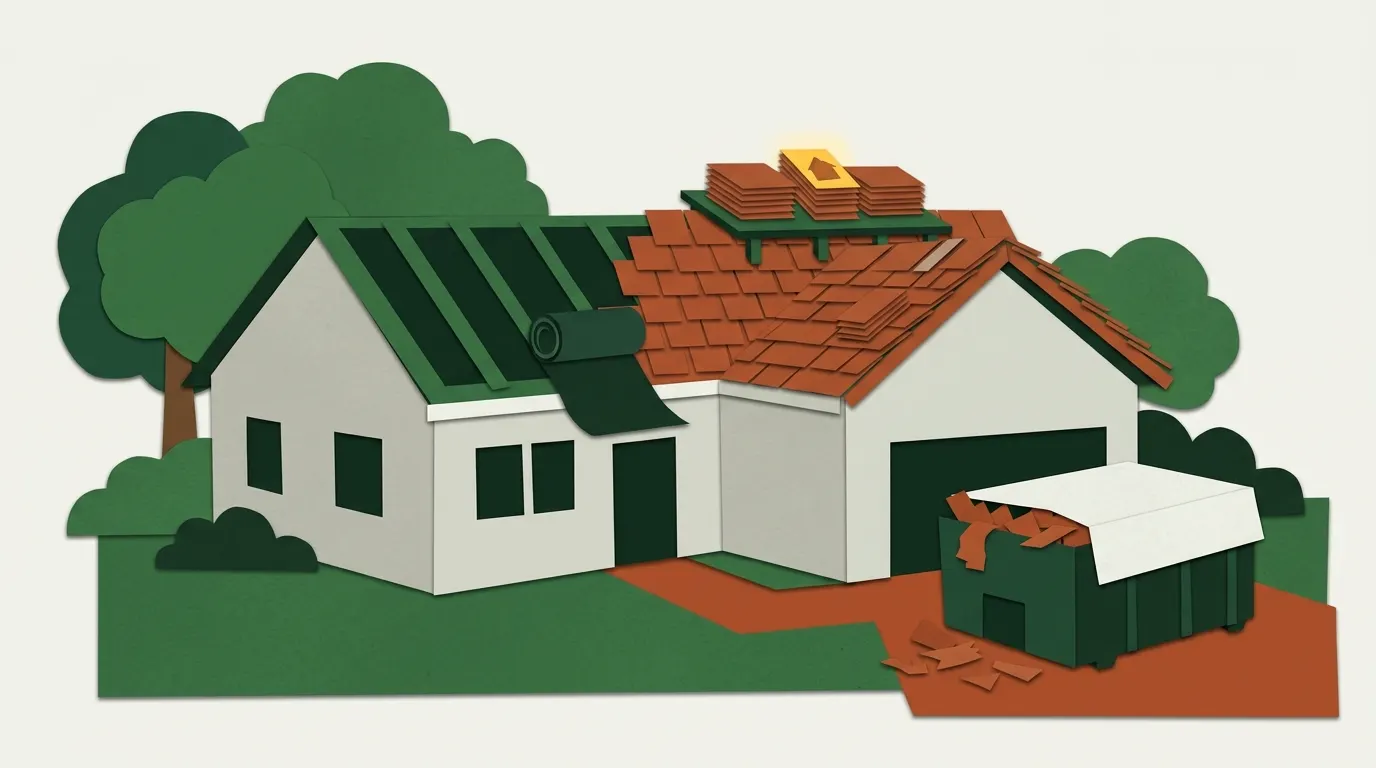
National ballpark · replacing a 2,000 sq ft asphalt shingle roof, including tear-off of one old layer
This is a planning range, not a quote.
Limited data: tear-off per square (one source). The real range may be wider.
| Cost | Low | Typical | High |
|---|---|---|---|
| Materials | $5,050 | $6,410 | $8,160 |
| Labor | $5,050 | $6,410 | $8,160 |
| Permit (varies by city) national | $110 | $310 | $500 |
| Total | $10,200 | $13,100 | $16,800 |
How this roofing calculator works
Start with your ZIP code. Then add the roof area in square feet, pick a roofing material and the pitch, and tell the calculator how many old layers have to come off. The tool multiplies your area by an installed price per square foot for the material, adds tear-off of the old roof by the square, adds a fixed amount for a steep roof and the permit, then adjusts everything for wages and prices in your state.
The result has three numbers. Low fits a simple roof, an easy driveway for the dumpster and a crew with open dates. Typical is where most quotes should fall. High covers complex roof lines, premium products and peak season. The breakdown splits the job into materials, labor and the permit, so you can line it up against a roofer's quote one row at a time.
Labor and materials are each about half of a roof bill in our data. The labor half is adjusted with construction wages from the Bureau of Labor Statistics, and the materials half with regional price levels from the Bureau of Economic Analysis. The permit stays at the national figure. The details are on How we calculate.
Roof area isn't the same as your home's floor area. Slope and overhangs make the roof bigger, so a roofer's measurement or a satellite measurement report will be closer than a guess from your floor plan. A roofer may also talk in squares: one square is 100 sq ft of roof.
Roof replacement cost by material
The material sets the price per square foot, and the gap between the cheapest and the most expensive option is wide. Basic asphalt shingles are the budget choice. Architectural shingles, which are thicker and layered for a more textured look, cost more. Metal and tile sit at the top.
| Option | Low | Typical | High | Unit |
|---|---|---|---|---|
| Architectural shingle | $5.30 | $9.15 | $13 | /sq ft |
| Asphalt shingle | $4.05 | $5.16 | $6.66 | /sq ft |
| Flat (TPO/EPDM) | $4.88 | $8.39 | $12 | /sq ft |
| Metal | $6.00 | $15 | $24 | /sq ft |
| Tile * | $13 | $22 | $22 | /sq ft |
* Limited data: one source, sources that disagree widely, or a single figure.
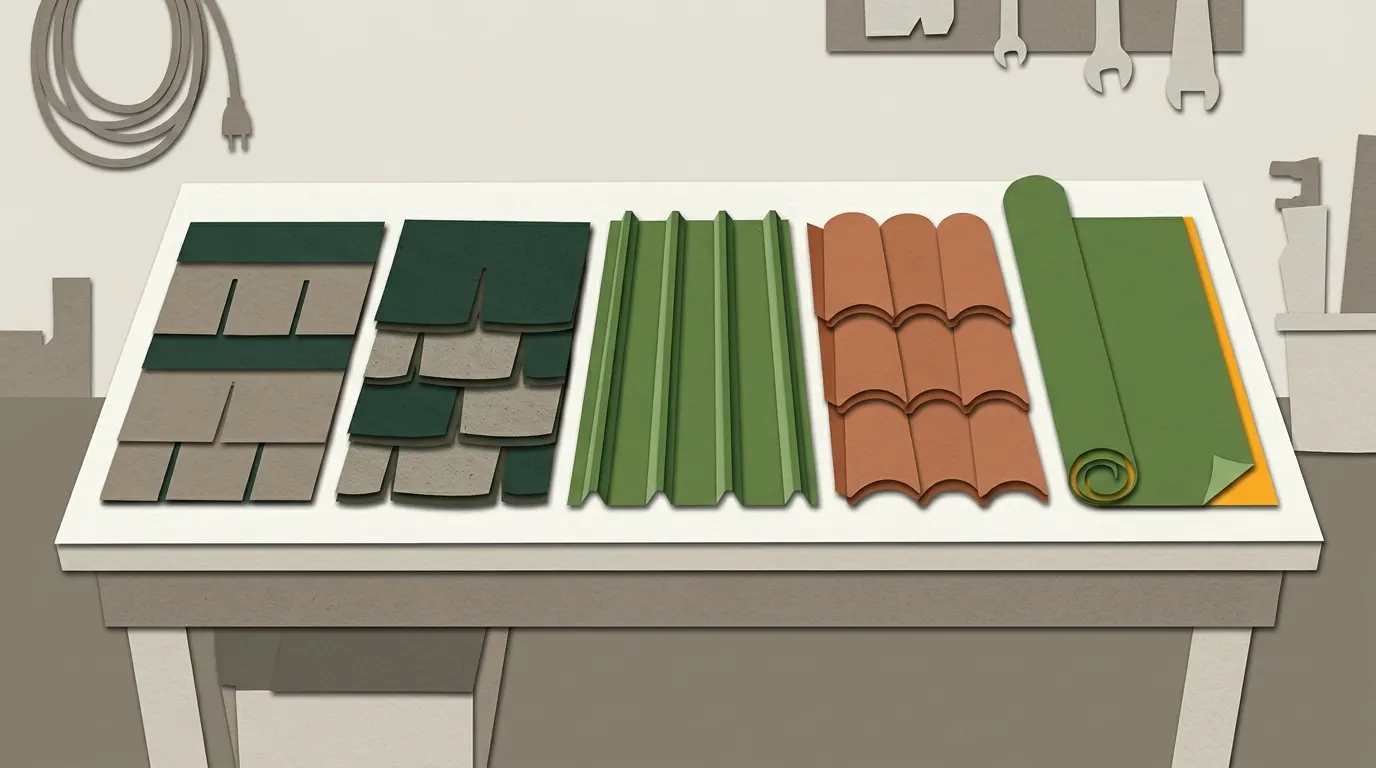
For our 2,000 sq ft example with tear-off and the permit, the totals look like this:
- Asphalt shingle: $10,200–$16,800, typical $13,100
- Architectural shingle: $12,700–$29,500, typical $21,100
- Flat (TPO/EPDM): $11,900–$27,300, typical $19,600
- Metal: $14,100–$51,400, typical $33,100
- Tile: $28,600–$47,900, typical $47,200
Tile needs a note. One source's typical price sits above other sources' highs, so the calculator caps the high price per square foot at the typical one, $22. That's why the tile total has almost no room above typical. Read the tile row as thin data.
If you've already settled on metal or a low-slope roof, the metal roof cost calculator prices corrugated, standing seam and metal shingles separately, and the flat roof replacement cost calculator does the same for TPO, EPDM, modified bitumen and built-up roofs.
What affects the price
Roof area
Area drives almost every line, because material, labor and tear-off are all priced by the foot or the square. A 1,500 sq ft roof costs roughly three quarters of our 2,000 sq ft example; a bigger or cut-up roof costs more. Enter your own area for a closer number.
Roofing material
This is the biggest lever. On our example, switching from basic to architectural shingles raises the typical price from $13,100 to $21,100, and metal raises it to $33,100. Material also changes the labor line, since heavier or more specialized products take longer to install.
Roof pitch
Pitch is how steep the roof is. A walkable roof is quicker to work on; a steep one needs harnesses, roof jacks and slower work. Our data adds $1,000–$3,000 for a steep roof, typical $2,000, which brings our example to $11,200–$19,800, typical $15,100. That figure comes from one source, NerdWallet, and the calculator treats low and medium pitch the same.
Tear-off of old layers
Our default includes removing one old layer of shingles. Tear-off is priced by the square: $100–$150 per square in one source, typical $130, and Fixr gives about $50 a square, rising to $150 for heavy materials or several layers. With no tear-off, our example drops to $8,210–$13,800, typical $10,600. We have only one per-square source for this line, so treat it as a rough guide.
The calculator charges the same for two old layers as for one, because our sources don't price a second layer separately. Fixr's note that heavier tear-offs run toward the top of its range is the best hint you'll get. If your roof has two layers, budget toward the high end and ask each roofer for a separate tear-off price.
Stories and access
A taller house means more lifting, more safety gear and a longer haul for old shingles. None of our sources price this for pitched roofs, so the calculator shows the same range for one, two or three stories. Tight lots, steep driveways and landscaping that needs protection add time too.
Decking and flashing
Under the shingles is the roof deck, the plywood or boards the roof is nailed to. Soft or rotted sections have to be replaced once the old roof is off, and nobody knows how much until then. Our data doesn't price decking repair or new flashing (the metal strips around chimneys, vents and walls), so ask how each roofer charges for them.
Roof replacement cost in Florida, Texas, California and other states
Labor is about 50% of a roof replacement in our data, so local construction wages explain much of the difference between states. For our 2,000 sq ft asphalt example, the typical price runs from $11,400 in Oklahoma and $11,700 in Mississippi and Wyoming to $15,400 in Minnesota and $16,000 in Illinois and New Jersey. Find your state, including Florida, Texas and California, in the table.
- Alabama$11,800
- Alaska$14,800
- Arizona$11,900
- Arkansas$11,800
- California$14,500
- Colorado$12,600
- Connecticut$13,700
- Delaware$13,300
- District of Columbia$14,300
- Florida$12,100
- Georgia$12,100
- Hawaii$14,300
- Idaho$13,200
- Illinois$16,000
- Indiana$13,100
- Iowa$11,900
- Kansas$11,800
- Kentucky$11,900
- Louisiana$12,000
- Maine$12,300
- Maryland$13,800
- Massachusetts$15,100
- Michigan$13,300
- Minnesota$15,400
- Mississippi$11,700
- Missouri$12,100
- Montana$13,300
- Nebraska$11,700
- Nevada$12,400
- New Hampshire$13,500
- New Jersey$16,000
- New Mexico$11,700
- New York$14,800
- North Carolina$12,200
- North Dakota$13,400
- Ohio$12,000
- Oklahoma$11,400
- Oregon$13,900
- Pennsylvania$13,100
- Rhode Island$13,700
- South Carolina$11,800
- South Dakota$11,900
- Tennessee$11,800
- Texas$11,900
- Utah$12,100
- Vermont$13,400
- Virginia$12,300
- Washington$14,000
- West Virginia$12,400
- Wisconsin$13,200
- Wyoming$11,700
The state factor doesn't know about local building rules, storm seasons or a sudden run of insurance claims after a hailstorm. All of these can push local quotes up for a while.
Ways to lower the cost
- Choose the material for the house, not the showroom. Basic or architectural shingles cover most homes for a fraction of what metal or tile costs.
- Measure once, quote the same roof. Give every roofer the same area, material and layer count so the quotes compare.
- Ask about overlay only if it fits. Skipping tear-off saves money now, but ask what it means for inspection of the decking and the next replacement.
- Fix the roof before it leaks inside. Planning a replacement gives you time to compare quotes; an emergency doesn't.
- Ask about scheduling. If your date can move, ask each roofer whether a slower month changes the price.
- Read the insurance side yourself. If a storm caused the damage, check your policy before you sign, and keep the roofer's line items for the adjuster.
Hiring tips
Ask at least three roofers to quote the same job: area, material, number of layers to remove and any decking allowance. Each quote should list materials, labor, tear-off and disposal, the permit and a price per sheet of replacement decking. Compare those rows with the breakdown above. A price well under our low number needs explaining, and the usual gaps are tear-off, underlayment (the layer under the shingles), flashing and ventilation.
Ask who pulls the permit and schedules the inspection, how the crew will protect your yard and gutters, and how they'll clean up nails from the lawn and driveway. Get the start date, the payment schedule and both warranties in writing: the manufacturer's warranty on the product and the roofer's warranty on the work. Check that the company has a license where your state requires one, and ask for proof of insurance. Bring the ballpark. Ask for the line items.
Other jobs on the outside of the house have their own calculators: the gutter installation cost calculator and the siding cost calculator. The whole group is on Roof & Exterior cost calculators.