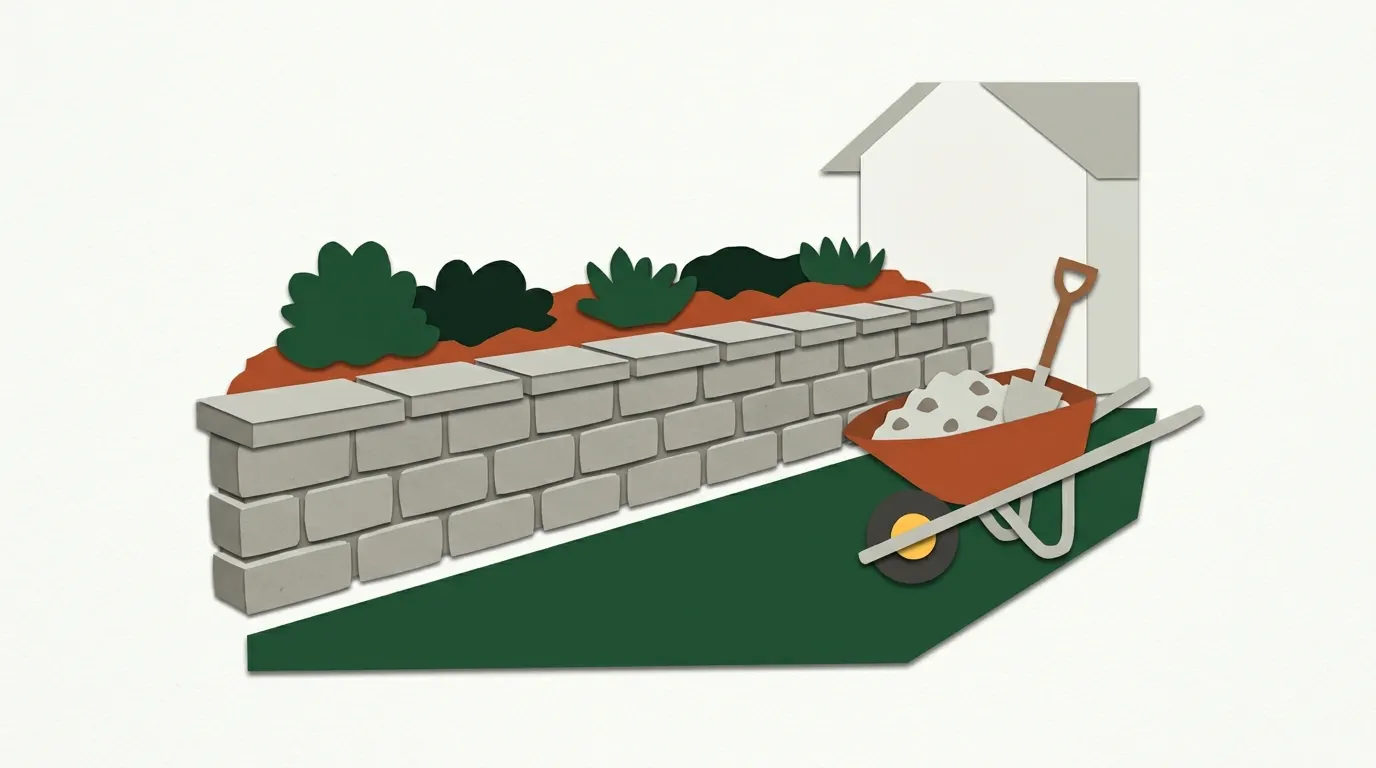
National ballpark · a 50 ft long, 3 ft high concrete block retaining wall
This is a planning range, not a quote.
Limited data: concrete block wall per sq ft of face (sources disagree); retaining wall permit (sources disagree). The real range may be wider.
| Cost | Low | Typical | High |
|---|---|---|---|
| Materials | $1,310 | $1,920 | $2,530 |
| Labor | $1,310 | $1,920 | $2,530 |
| Permit (varies by city) national | $45 | $230 | $420 |
| Total | $2,670 | $4,080 | $5,480 |
How this retaining wall cost calculator works
Enter your ZIP code, the length of the wall in linear feet, its height in feet and the material. The calculator multiplies length by height to get the area of the wall face, prices that area at an installed rate per square foot for your material, adds a permit, then adjusts the result for wages and prices in your state.
You get three numbers. Low is a simple wall on firm, flat ground with easy access for the crew and materials. Typical is where most quotes land. High covers awkward sites, heavier materials and walls that need more work behind them than you can see. The breakdown splits the bill into materials, labor and the permit, so you can set it beside a contractor's quote line by line.
Once your wall reaches 4 feet tall, the result also shows an engineer's design price as a separate reference line. It isn't added to the total, because whether you need one depends on your city and your site.
The state adjustment uses construction wages from the Bureau of Labor Statistics for the labor half and regional price levels from the Bureau of Economic Analysis for the materials half. Permit fees stay at national levels. The full method is on How we calculate.
Retaining wall cost by material
Material sets the rate per square foot of wall face. Timber and concrete block share the same low end, poured concrete costs a little more, and natural stone has both the highest typical price and by far the widest range.
| Option | Low | Typical | High | Unit |
|---|---|---|---|---|
| Concrete block * | $18 | $26 | $34 | /sq ft |
| Natural stone | $20 | $48 | $75 | /sq ft |
| Poured concrete * | $23 | $31 | $40 | /sq ft |
| Timber | $18 | $21 | $24 | /sq ft |
* Limited data: one source, sources that disagree widely, or a single figure.
Our sources disagree a lot on concrete block and poured concrete prices, so treat those two ranges as rough.
For our 50-foot, 3-foot-high example, the totals come out like this:
- Timber: $2,670–$3,980, typical $3,330
- Concrete block: $2,670–$5,480, typical $4,080
- Poured concrete: $3,420–$6,420, typical $4,920
- Natural stone: $3,050–$11,700, typical $7,360
Block, stone, poured concrete or timber?
Concrete block here means interlocking landscape block: units that stack without mortar and lock into each other. It's the middle choice on price and the most common pick for garden walls. Timber costs the least on a typical job and suits low garden beds and borders; ask each installer how the boards are treated against rot. Poured concrete is cast in forms on site, which takes more labor and equipment. Natural stone has the biggest spread, because a dry-stacked wall of local fieldstone and a cut-stone wall are very different jobs.
If you only want to compare materials, a single source gives prices for the material alone, before installation: about $8 per square foot for poured concrete, $11 for concrete block and $25 for natural stone. The rest of the installed price is labor, base, backfill and equipment.
What affects the price
Wall face area
The calculator treats price as rate times face area, so doubling the length or the height roughly doubles the materials and labor lines. Height does more than that in practice. A taller wall holds back more soil, so it usually needs a deeper base, more gravel behind it and sometimes steel reinforcement or an engineer. Those extras aren't in the per-square-foot rates.
Material
Moving from timber to natural stone can more than double the bill. On our example the typical price rises from $3,330 for timber to $7,360 for stone, and the high end for stone reaches $11,700.
Engineering
From 4 feet up, the calculator shows an engineer's design at $200–$500, typical $350, as a reference. Only one source gives this price, so use it as a rough guide. Ask your city at what height a wall needs a stamped design where you live.
Drainage
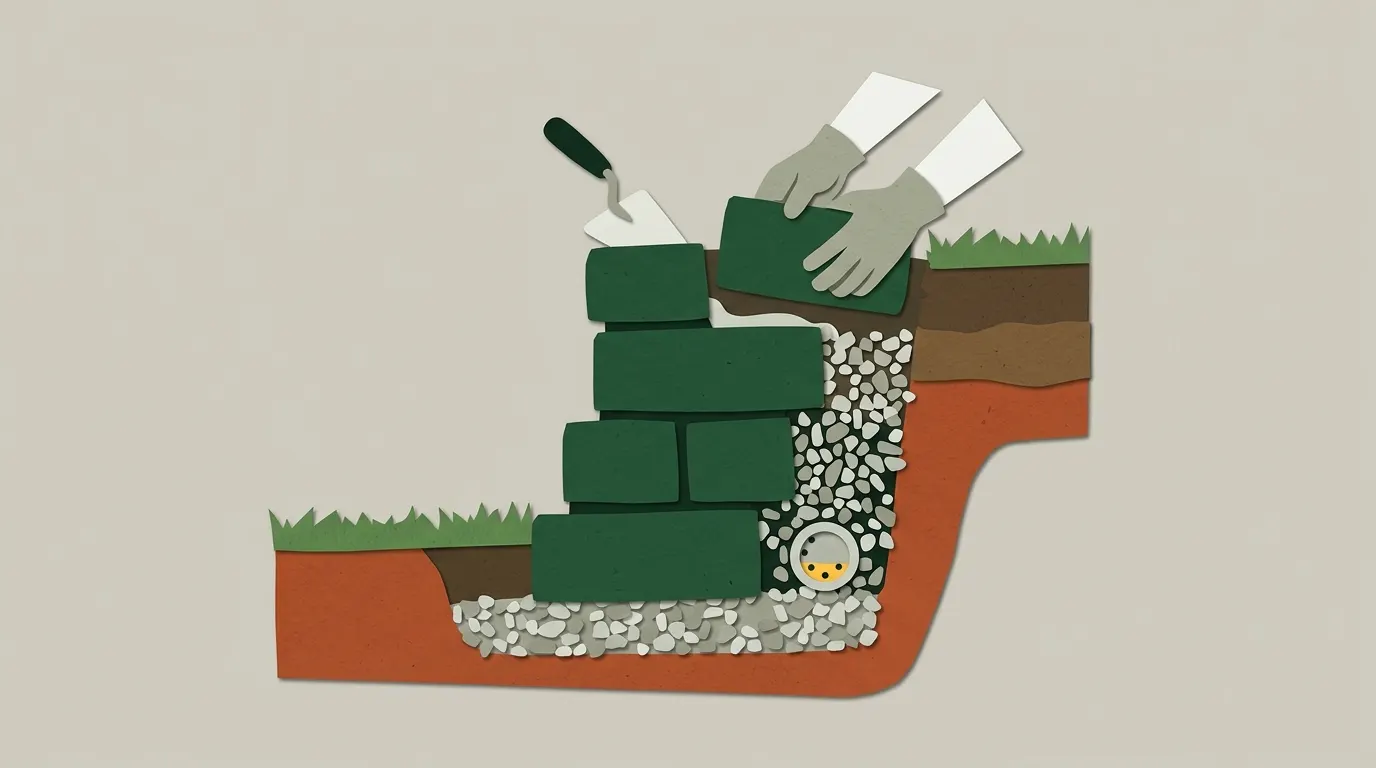
Water trapped behind a wall adds pressure on it. A good wall has gravel backfill and a drain pipe at the base, which most installers include in their price. Adding drainage behind a wall that already stands costs $60–$70 per linear foot in our data. A full French drain (a gravel trench with a perforated pipe) is a separate job; one source puts it at $1,650–$12,300, and our French drain cost calculator prices it on its own.
Reinforcement and waterproofing
Some walls get steel rebar or a waterproof coating on the back face. Rebar runs $1.15–$2.05 per square foot, typical $1.60, and waterproofing $2–$10, typical $6. Several sources say waterproofing is already in their overall wall price, so check whether your quote lists it twice.
Site work
Digging out a slope, hauling soil and pouring a footing (the concrete strip a heavy wall sits on) all add cost. Single sources put excavation at $50–$200 per cubic yard and a concrete footing at $30–$100 per linear foot. The calculator doesn't add either, which is one reason the high end sits well above typical.
Permit
Permit fees in our data run $45–$420, typical $230. Sources disagree widely, and many small garden walls need no permit at all.
What this calculator doesn't price
The total covers the wall itself and a permit. It leaves out removal of an old wall, extra drainage, a French drain, excavation beyond normal prep, footings, the engineer's design (shown only as a reference from 4 feet up), steps, lighting and planting. If your project has any of those, add them to your budget using the numbers above or ask each contractor to price them as separate lines.
Retaining wall cost by state
Labor is about half of a retaining wall bill, so local wages explain most of the gap between states. For our 50-foot concrete block example, the typical price runs from $3,540 in Mississippi, $3,600 in Oklahoma and $3,670 in Alabama to $4,630 in Alaska, $4,700 in Washington and $5,080 in Hawaii.
- Alabama$3,670
- Alaska$4,630
- Arizona$3,730
- Arkansas$3,680
- California$4,410
- Colorado$4,090
- Connecticut$4,420
- Delaware$3,930
- District of Columbia$4,500
- Florida$4,020
- Georgia$3,860
- Hawaii$5,080
- Idaho$4,060
- Illinois$4,540
- Indiana$3,770
- Iowa$3,980
- Kansas$3,970
- Kentucky$3,910
- Louisiana$3,670
- Maine$4,250
- Maryland$3,910
- Massachusetts$4,490
- Michigan$4,010
- Minnesota$4,320
- Mississippi$3,540
- Missouri$3,770
- Montana$4,210
- Nebraska$3,970
- Nevada$4,370
- New Hampshire$4,200
- New Jersey$4,420
- New Mexico$3,790
- New York$4,180
- North Carolina$3,910
- North Dakota$4,070
- Ohio$3,790
- Oklahoma$3,600
- Oregon$4,400
- Pennsylvania$4,100
- Rhode Island$4,250
- South Carolina$3,860
- South Dakota$3,870
- Tennessee$3,780
- Texas$3,790
- Utah$3,910
- Vermont$4,340
- Virginia$3,920
- Washington$4,700
- West Virginia$3,750
- Wisconsin$4,440
- Wyoming$3,950
Ways to lower the cost
- Keep the wall low where you can. Two short terraced walls can sometimes replace one tall wall, which may avoid an engineer. Ask a contractor whether your slope allows it.
- Choose block or timber for a garden wall that doesn't hold up a driveway or a building.
- Measure the face first. Length times height is what you're paying for, so a few feet less wall shows up right away in the price.
- Plan drainage now. Adding it later costs $60–$70 per linear foot on its own.
- Ask about tear-out separately. If an old wall has to go, get that priced as its own line so you can compare.
Hiring tips
Get at least three written quotes for the same wall: same length, height, material and drainage. Ask each contractor to list materials, labor, base and backfill, drainage, removal and the permit as separate lines, then compare them with the breakdown above. A price well below our low number deserves questions about how deep the base goes and what sits behind the wall.
For a wall 4 feet or taller, or one that holds up a driveway, a slope near the house or a neighbor's yard, ask who provides the engineered design and who pulls the permit. Get the warranty, payment schedule and cleanup terms in writing. Check that the company has a license where your state requires one, and ask for proof of insurance. Bring the ballpark. Ask for the line items.