This page covers stucco only. For vinyl, wood, fiber cement and brick, use the main siding cost calculator. Stucco is a cement plaster troweled onto the outside of a house in wet layers that harden into a hard, seamless shell.
National ballpark · 2,000 sq ft of stucco siding on a one-story house
This is a planning range, not a quote.
Limited data: siding permit (sources disagree). The real range may be wider.
Removing old siding is extra and usually priced per job; ask whether it is in the quote.
| Cost | Low | Typical | High |
|---|---|---|---|
| Materials | $7,700 | $9,350 | $11,000 |
| Labor | $6,300 | $7,650 | $9,000 |
| Permit (varies by city) national | $150 | $290 | $1,500 |
| Total | $14,200 | $17,300 | $21,500 |
How the stucco cost calculator works
Stucco is preset as the material. Fill in your ZIP code, the wall area and the number of stories. The estimate is your area times an installed stucco price per square foot, plus an access charge for a taller house and a permit, then shifted for wages and prices in your state.
For the 2,000 sq ft example, the breakdown shows materials at $7,700–$11,000, typical $9,350, and labor at $6,300–$9,000, typical $7,650. The permit adds $150–$1,500, typical $290. Our sources disagree a lot on permit fees, so that line is a rough guide. The calculator uses a 45% labor share for all siding; stucco is skilled plaster work, so on many jobs labor may be a bigger part of the bill. The method is explained on How we calculate.
Stucco cost per square foot
Installed, stucco runs $7–$10 per square foot, typical $8.50. Five sources price it, and their numbers sit close together compared with brick or fiber cement.
| Option | Low | Typical | High | Unit |
|---|---|---|---|---|
| Brick veneer * | $8.00 | $15 | $18 | /sq ft |
| Engineered wood | $1.00 | $5.25 | $9.50 | /sq ft |
| Fiber cement * | $6.00 | $10 | $14 | /sq ft |
| Stucco | $7.00 | $8.50 | $10 | /sq ft |
| Vinyl | $3.00 | $7.00 | $11 | /sq ft |
| Wood * | $5.50 | $9.00 | $15 | /sq ft |
* Limited data: one source, sources that disagree widely, or a single figure.
Labor alone runs $2–$9 per square foot, typical $3.30, from two sources. The high end of that labor figure reflects hard jobs: tall walls, lots of corners and windows, or a fine finish that takes extra passes. Two sources that price a whole stucco project give $10,800–$17,300, close to our typical result.
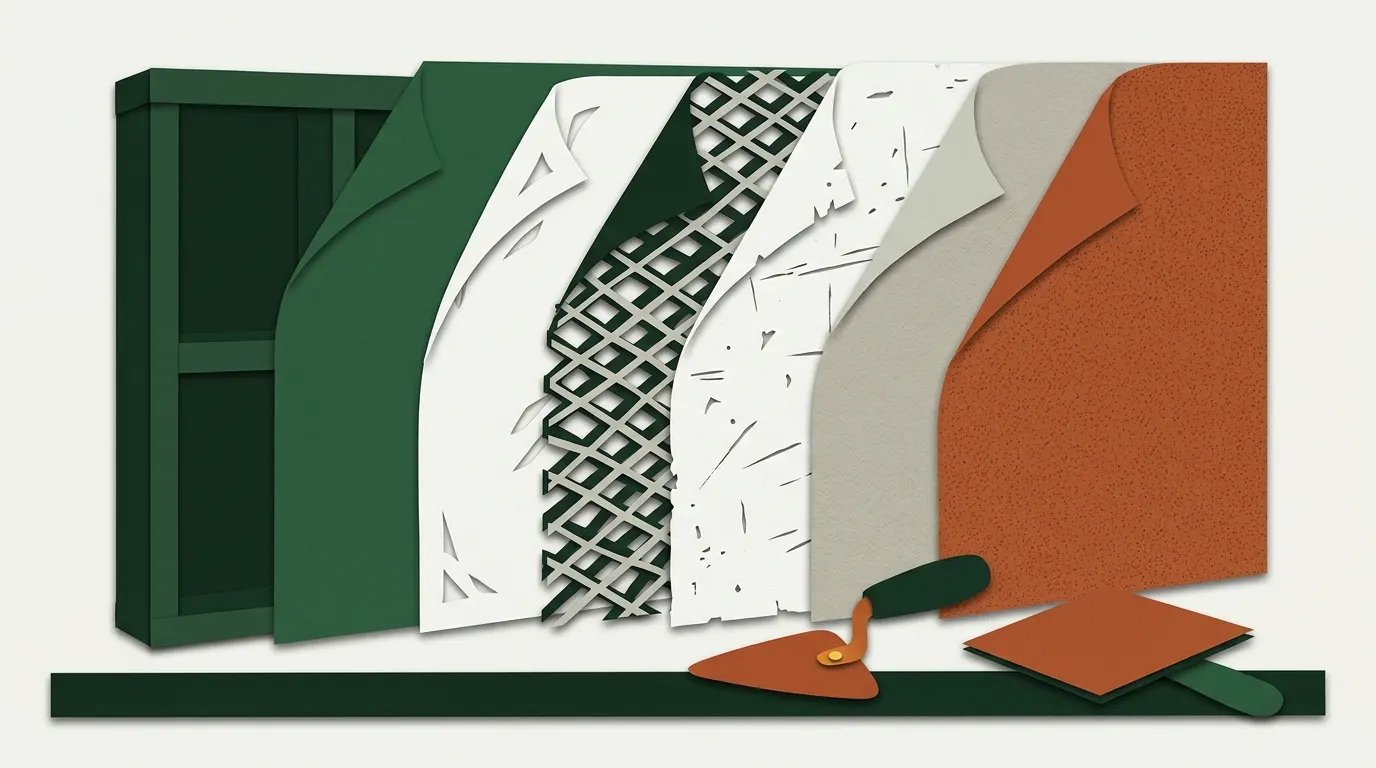
How stucco goes on
Knowing the layers helps you read a quote, because each one is labor and material.
Weather-resistant barrier. Building paper or house wrap goes over the sheathing to keep water that gets through the stucco away from the wood behind it.
Lath. Metal mesh is fastened over the barrier so the plaster has something to grip.
Scratch coat. The first layer of plaster is pressed into the lath and scored with lines so the next coat bonds.
Brown coat. The second layer builds thickness and flattens the wall.
Finish coat. The last thin layer carries the texture and, often, the color. Common textures include sand, dash (a rough spatter) and smooth troweled finishes.
That's traditional three-coat stucco. One-coat systems combine the first two coats into one thicker layer over foam or sheathing and go on faster. Synthetic stucco, or EIFS, uses foam board and an acrylic finish instead of cement plaster. Our data doesn't price these systems separately, so confirm which one your quote describes.
Stucco compared with other siding
On the same 2,000 sq ft, one-story example, stucco's typical price of $17,300 lands near wood at $18,300, above vinyl at $14,300 and below fiber cement at $20,300. Brick veneer costs far more at $30,300.
What sets stucco apart is the shape of its range. From $14,200 to $21,500 is a narrow spread for siding, so a stucco quote that lands far outside it deserves a closer look. Stucco doesn't need painting if the color is mixed into the finish coat, won't rot and doesn't attract insects, and suits warm, dry places. It can crack as a house settles, and hairline cracks are common. Repairs need a plasterer who can match the texture, and patches can show. For a lighter, quicker material, the vinyl siding cost calculator runs the same inputs.
What affects the price
Wall area
The plaster line grows with every square foot. Gable ends, chimney chases and bump-outs add area and corners; each outside corner and window edge needs metal trim and careful hand work.
Stories
A taller house adds $500–$2,500 for access, typical $1,500, from one source. Stucco crews often need scaffolding on upper walls rather than ladders. That puts the example at $14,700–$24,000, typical $18,800. Our data treats three stories the same as two, so a three-story quote may run higher.
Removal and wall prep
Removal isn't in the calculator. Stripping old stucco runs $1–$3 per square foot in one source, typical $2. Removing lap siding first, or adding sheathing so stucco has a solid base, adds labor too. Over masonry, prep is usually lighter.
Finish and color
A plain sand finish in a standard color is the usual starting point. Smooth finishes, custom colors and decorative trim bands or foam moldings take more time. Our data doesn't price finishes separately, so they push quotes toward the top of the range.
Weather and timing
Stucco has to cure, and crews avoid freezing nights, heavy rain and very hot, dry days that make it set too fast. In some regions that narrows the working season. If your timeline is tight, ask how weather could shift the schedule.
Stucco cost by state
Stucco is labor-heavy, so local wages explain most of the gap between states. For the 2,000 sq ft example, the typical price runs from $15,000 in Oklahoma, $15,100 in Arkansas and $15,300 in South Dakota to $19,800 in California, $20,000 in Illinois and $21,500 in Hawaii.
- Alabama$15,400
- Alaska$19,600
- Arizona$16,600
- Arkansas$15,100
- California$19,800
- Colorado$17,400
- Connecticut$17,500
- Delaware$16,800
- District of Columbia$18,000
- Florida$15,800
- Georgia$15,800
- Hawaii$21,500
- Idaho$15,900
- Illinois$20,000
- Indiana$17,200
- Iowa$16,300
- Kansas$16,300
- Kentucky$15,900
- Louisiana$15,300
- Maine$17,200
- Maryland$17,800
- Massachusetts$19,000
- Michigan$17,100
- Minnesota$17,900
- Mississippi$15,400
- Missouri$17,000
- Montana$16,700
- Nebraska$15,400
- Nevada$17,200
- New Hampshire$17,200
- New Jersey$18,400
- New Mexico$16,800
- New York$19,400
- North Carolina$15,500
- North Dakota$16,500
- Ohio$16,700
- Oklahoma$15,000
- Oregon$18,100
- Pennsylvania$17,100
- Rhode Island$17,100
- South Carolina$15,700
- South Dakota$15,300
- Tennessee$15,700
- Texas$15,600
- Utah$15,900
- Vermont$17,300
- Virginia$16,700
- Washington$19,400
- West Virginia$15,500
- Wisconsin$16,900
- Wyoming$16,400
Ways to lower the cost
- Choose a standard texture and color. A sand finish with integral color needs no paint and less hand work than smooth or custom finishes.
- Keep decorative bands simple. Each foam molding or trim band adds labor.
- Plan around the weather. Booking in a mild season avoids weather delays and the extra cost of protecting fresh stucco.
- Repair before you replace. If the old stucco is sound with a few cracks, ask what a patch-and-recoat would cost compared with new stucco.
- Combine walls. Doing all sides at once keeps one crew and one scaffold setup instead of several visits.
Hiring tips
Get at least three written quotes for the same stucco job: the same wall area, system (three-coat, one-coat or EIFS), texture and color. Ask each contractor to list wall prep, barrier and lath, the coats, trim, removal and disposal, scaffolding and the permit as separate lines, then compare them with the breakdown above.
Ask how the wall will shed water. Good stucco details include a weep screed (a metal strip at the bottom of the wall that lets moisture drain out), flashing around windows and doors, and sealant at joints. Ask how long each coat cures before the next, and who checks the work if your city requires inspections between coats. I'd ask for a written plan for cracks: what the contractor considers normal and what they'll fix. Check for a license where your state requires one and for proof of insurance. Bring the ballpark. Ask for the line items.